If you need professional surveillance services or a licensed private investigator in Dallas, our team provides discreet, accurate, and legally documented investigative findings to give you clarity and peace of mind.
- Introduction
Vehicle tracking has quietly become one of the most common surveillance concerns
Most people imagine surveillance as something dramatic a stranger sitting in a parked car watching from across the street, or someone physically following them through traffic.
GPS tracker technology has made it easier than ever for someone to monitor a vehicle’s location without being physically present. These devices are small, affordable, and widely available, which has raised concerns for many people who wonder whether their movements could be tracked without their knowledge.
At Terrance Private Investigator & Associates, we frequently receive calls from clients in Dallas who suspect a GPS tracker may have been placed on their vehicle. This insight explains the signs to look for and what steps to take if you believe someone may be tracking your movements.
This insight explains how GPS tracking works, the behavioral signs that sometimes accompany it, and what steps to take if you believe someone may be monitoring your vehicle.
- Explanation
To understand GPS tracking, you first have to understand how the technology works
Global positioning technology allows small electronic devices to determine their location by communicating with satellites orbiting the Earth. When attached to a vehicle, these devices can transmit location information through cellular networks, allowing the person monitoring the device to see where the vehicle travels throughout the day.
Most consumer GPS trackers are inexpensive, easy to purchase online, and simple to activate. Many require only a mobile application and a subscription plan.
This accessibility is what makes the technology both useful and concerning. While GPS tracker devices are often used for legitimate purposes, unauthorized placement raises serious privacy concerns.
Businesses frequently use GPS trackers for legitimate reasons managing delivery vehicles, protecting company assets, and improving logistics efficiency. The technology itself is not inherently problematic.
The issue arises when someone places a device on a vehicle without the owner’s knowledge or consent.
Privacy laws surrounding electronic monitoring can vary by state, and guidance regarding lawful surveillance practices is often addressed by agencies such as the U.S. Department of Justice.
For individuals who believe they may be under surveillance, the challenge is determining whether the concern is based on coincidence or whether there are actual indicators that tracking could be occurring.
Signs That May Suggest a GPS Tracker on a Vehicle
Unusual Knowledge of Your Location
One of the first warning signs is when someone appears to know where you’ve been or references your schedule without being told. Occasional coincidences happen, but repeated comments about places you visited or unexpected appearances can raise questions about how that information was obtained.
Repeated Coincidences That Feel Too Consistent
Some individuals begin noticing the same person appearing in locations connected to their routine parking lots, restaurants, or other public places. While coincidences do occur, a pattern of repeated encounters may warrant a closer look.
An Unfamiliar Device on Your Vehicle
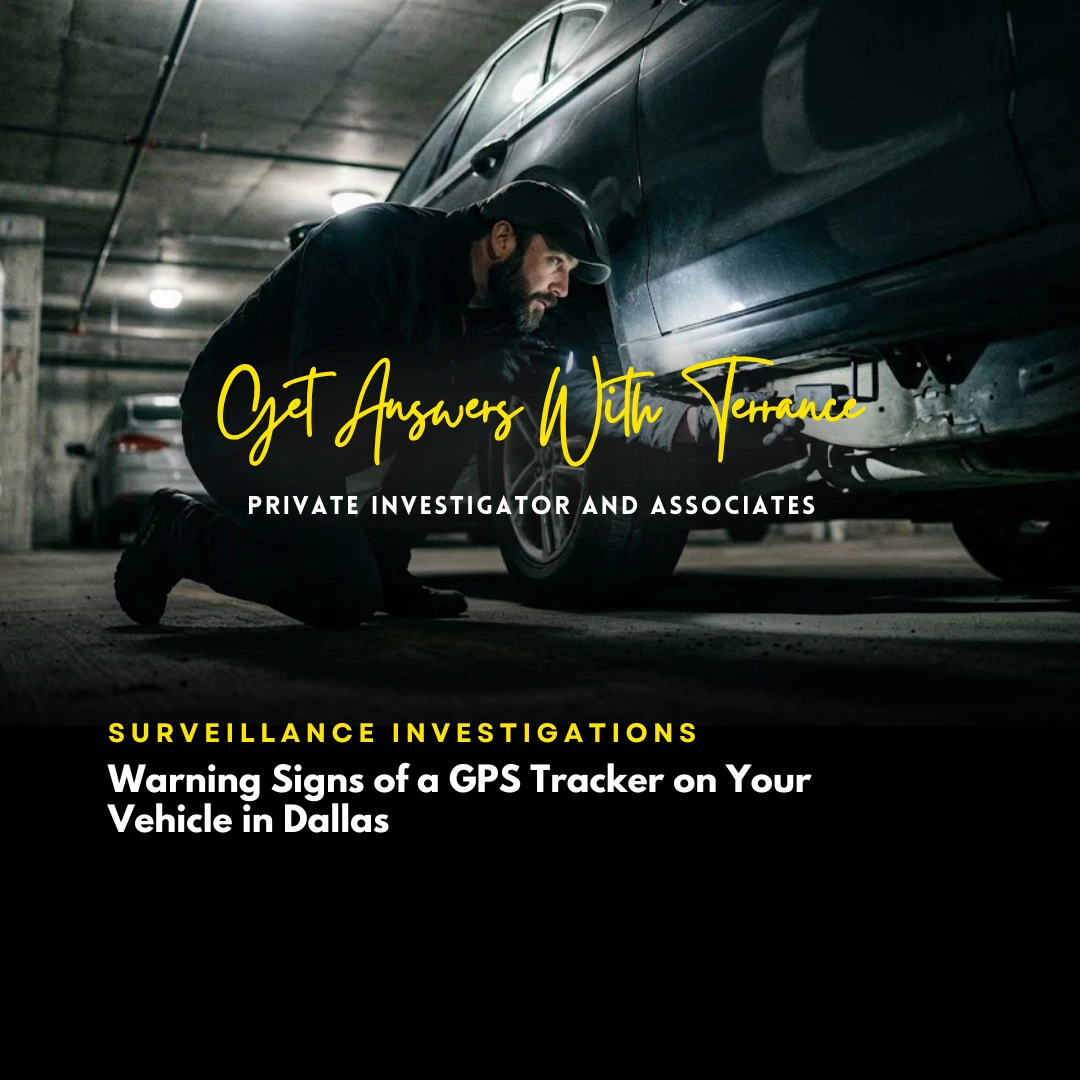
Many GPS trackers are small, magnetized devices that can attach discreetly to a vehicle. Common placement areas include under the rear bumper, inside wheel wells, beneath the chassis, or behind license plates. A careful inspection may reveal unfamiliar equipment attached to the vehicle.
Warning Signs That Warrant Closer Attention
Certain patterns often prompt individuals to question whether their vehicle may be monitored.
- someone referencing your movements in ways that seem unusually precise
• unexpected encounters with the same individual at multiple locations
• unfamiliar devices discovered during a routine inspection of your vehicle
• repeated comments about your schedule from someone who should not know it
• concerns involving stalking, harassment, or high-conflict personal relationships
It is important to remember that these behaviors do not automatically confirm surveillance. They simply represent situations where further verification may be appropriate.
- Real-world insight
Surveillance concerns often emerge during periods of personal conflict
Across investigations conducted in the Dallas–Fort Worth area, concerns about GPS tracking most frequently appear in situations involving strained personal relationships.
High-conflict divorces.
Contentious custody disputes.
Business disputes between former partners.
During these situations, individuals sometimes begin to notice patterns that raise questions about whether their movements are being monitored.
In many cases, no GPS tracker is present.
But in cases where a device is discovered, the pattern often follows a familiar structure: a small magnetized tracker attached to the underside of a vehicle, paired with a mobile application that allows another individual to observe travel activity remotely.
The technology itself leaves very little visible evidence.
But the behavioral patterns surrounding it unexplained knowledge of someone’s movements or unexpected encounters are often what lead individuals to investigate further.
- Professional perspective
Verifying Surveillance Requires Methodical Inspection
Professional investigators approach potential tracking cases carefully and objectively.
The first step is always verification.
Investigators conduct systematic inspections of the vehicle, examining common attachment points and areas where a device could realistically be placed. This process may involve physical inspection as well as electronic detection equipment designed to identify transmitting devices.
If a device is discovered, investigators document its presence, photograph its location, and determine whether it is actively transmitting data.
It is also important to approach these situations within the boundaries of the law. Surveillance and electronic monitoring laws vary depending on the jurisdiction, and improperly obtained evidence may not be admissible in legal proceedings.
The role of the investigator is not confrontation.
It is documentation.
Accurate documentation allows individuals and attorneys to understand what is actually occurring and determine what steps should be taken next.
- When to consider investigation
When to Consider Taking Action
Consider contacting a professional investigator if the following conditions exist:
- you have noticed multiple unusual patterns involving your movements
• someone appears to have knowledge of your schedule that you did not share
• you have discovered an unfamiliar device attached to your vehicle
• the situation involves harassment, stalking concerns, or a high-conflict personal dispute
• you require documentation for potential legal proceedings
A professional investigation is not about escalating conflict. It is about establishing facts.
Once the facts are known, individuals can make informed decisions about their safety, their privacy, and their next steps.
Helpful Links
Pew Research Center — Research on Digital Technology and Privacy
U.S. Department of Justice — Guidance on Electronic Surveillance and Privacy
National Network to End Domestic Violence — Technology Safety Resources
- FAQ"s
Frequently Asked Questions
How quickly can a surveillance inspection be conducted?
In many cases, vehicle inspections for tracking devices can be performed quickly once an appointment is scheduled. The process typically involves a detailed physical inspection of the vehicle and any areas where a device could realistically be attached.
Is it legal for someone to place a GPS tracker on my vehicle?
The legality of GPS tracking can depend on several factors, including who owns the vehicle and the laws of the state where the device is used. In some cases, tracking a vehicle without the owner’s knowledge may raise privacy concerns or legal issues.
What types of investigations do you handle in Dallas?
We handle infidelity and cheating spouse investigations, surveillance operations, background checks, child custody investigations, asset searches, missing person cases, and corporate investigations throughout the Dallas–Fort Worth metroplex and across Texas.
How do I know if my car has a hidden GPS tracker?
Some trackers can be discovered through a physical inspection of the vehicle, particularly around the chassis, wheel wells, or rear bumper. Because many devices are small and magnetized, professional inspection is often the most reliable method.
Will my case remain confidential?
Absolutely. Confidentiality is foundational to everything we do. All communications, case details, investigative methods, and findings are fully protected. We do not share information with any third party without your explicit written consent.
For the best results, consider hiring a reliable Dallas Private Investigator for your needs.
Should I remove a GPS tracker if I find one?
If you discover an unfamiliar device, it may be advisable to document its location before removing it. Photographing the device and consulting with a professional investigator or legal professional can help ensure the situation is handled appropriately.
Can a private investigator locate a GPS tracking device?
Yes. Professional investigators have experience identifying common placement locations and may use specialized equipment to detect transmitting devices attached to vehicles.
- Final Perspective
Modern surveillance technology has made vehicle tracking easier than ever
Small GPS devices have created a world where monitoring someone’s movements can happen quietly and remotely.
But technology leaves traces.
If something about your situation feels unusual repeated coincidences, unexpected knowledge of your movements, or the discovery of an unfamiliar device the most important step is verifying the facts.
Clarity replaces uncertainty.
And when your privacy and safety are involved, clarity matters.
- Contact Us
Get Answers. Get Results.
Contact Terrance Private Investigator & Associates
 Email: getanswers@piterrance.com
 Website: https://piterrance.com/
 Call or Text: 214-838-8004
Insights