
CASE OVERVIEW
What Javier brought us was not a single question. It was a map with several addresses on it and a need to understand what was actually happening at each one.
Not every custody investigation begins with a single location and a clear operational target. Some begin the way Javier’s did: with a subject whose movements were spread across multiple addresses in the Dallas and surrounding area, a set of children whose actual daily living situation was not clearly established, and a client who needed documented answers about both before he could take any meaningful legal step.
Javier had concerns about where his children were living and what the subject’s actual daily routine looked like when no one was watching. He had addresses, vehicle information, and a general picture of the people and locations associated with the subject and her family. What he did not have was a documented record of which addresses were actually active, which ones the children were connected to, and where the subject herself was spending her time. That kind of documented picture does not come from a single day of surveillance at a single location. It comes from the methodical work of checking multiple addresses across multiple days, adapting the operational approach as information develops, and building the picture one confirmed fact at a time.
Our investigators worked across the Balch Springs, Forney, and Mesquite areas of the Dallas metro over the course of the investigation window. The subject proved difficult to locate directly across the majority of the surveillance days. What the investigation did confirm, clearly and with documented specificity, was the residential and school situation of the children, the observation of the subject and the person of interest together during a child exchange, and a detailed picture of the address network associated with the subject’s family that gave Javier’s attorney a factual foundation to work from.
Client name and identifying details have been changed. This case study is published with permission.
THE CHALLENGE
Multiple addresses, a subject who was not where she was expected to be, and a family associate who noticed the surveillance before it was done.
Custody surveillance investigations involving multiple potential addresses present a specific operational challenge: the investigator cannot be at every location simultaneously, and the subject can be at any one of them or none of them on any given day. The operational approach has to be adaptive, rotating between addresses based on vehicle sighting data, employment location intelligence, and the developing picture of which addresses are generating the most activity. The documented record at the end of this kind of investigation reflects not just what was observed but the systematic approach that was used to build the most complete picture the operational window allowed.
This case carried three specific challenges that shaped every day of the investigation.
The first was subject availability. The subject was not located at her workplace, at the primary residential addresses, or in transit between them across the majority of the surveillance days. Locating a subject who is not where the available information suggested she would be requires the investigator to work the address network methodically, checking each location in sequence rather than committing to a single position and waiting.
The second was a mechanical disruption on one of the surveillance days. The investigator’s vehicle began overheating during active surveillance, requiring a temporary departure to address the mechanical issue before returning to the field the same evening. The investigation continued without permanent disruption, but it illustrates the kind of real-world operational variable that professional investigators manage in the field as a matter of course.
The third was counter-surveillance awareness within the subject’s family network. On one surveillance day, the subject’s brother approached the investigator’s surveillance position in what appeared to be an attempt to confront the investigator. The investigator immediately departed the immediate area, repositioned to a nearby school parking lot, and resumed surveillance without further incident. The integrity of the operation was preserved and the investigation continued.
THE INVESTIGATION
Four surveillance days, four addresses worked, one child exchange documented, and a picture of the children’s actual living situation that Javier did not have before he called us.
The investigation ran across four active surveillance dates in August 2026, covering addresses in Balch Springs, Forney, and Mesquite. Here is how the documented picture came together across each phase of the operation.
August 21: the child exchange and the first confirmed observation of the subject and person of interest together
Our investigator arrived at the Balch Springs location in the early evening. The subject and the person of interest were observed together in the parking lot conducting a child exchange. That observation was documented as the clearest and most direct observation of the operational window: both parties together, at a known location, in a documented context that confirmed their ongoing contact and the custody exchange arrangement that was in place.
A child exchange is a specific kind of moment in a custody investigation. It tells the investigator not just that two parties are in contact but that there is an active custody arrangement operating between them, and it raises the question of where the children are going after the exchange and what the residential situation looks like at the receiving end. The August 21 observation gave our investigators a direction to work in for the days that followed.
August 24: three addresses checked, no subject located, but the children’s residence confirmed
The investigator began the August 24 surveillance day at the primary residential address at approximately 05:30 hours. Lights were observed inside the residence but the subject’s vehicle was not present. Surveillance was maintained through the morning hours with no relevant activity observed.
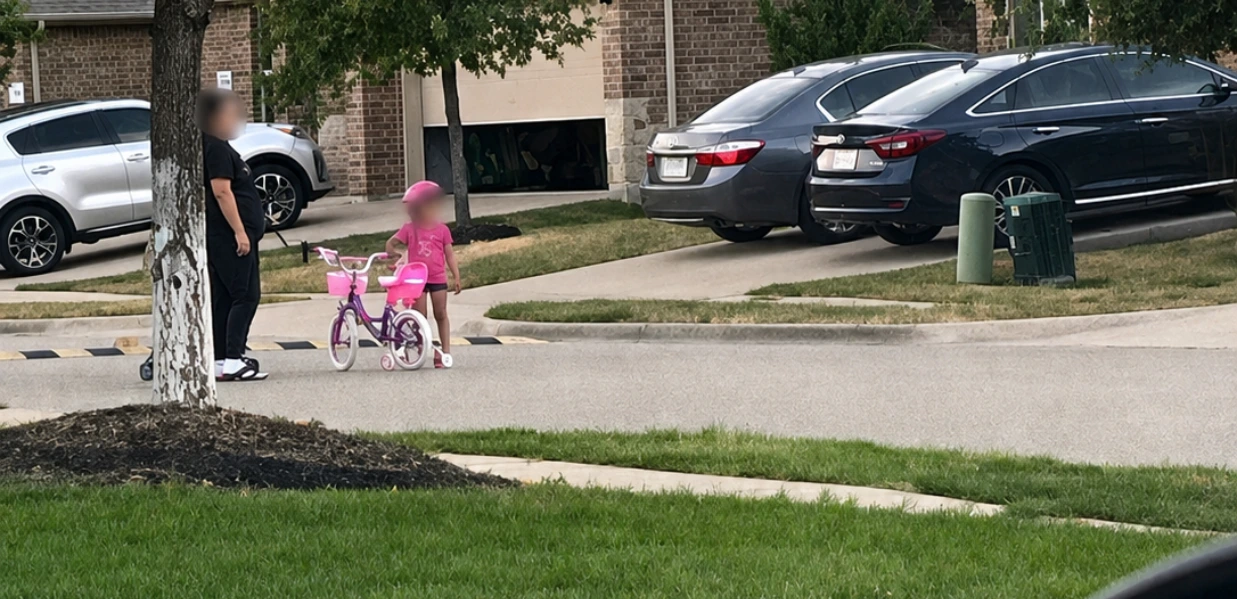
By early afternoon it was clear the subject was not at the primary address, and the investigator traveled to the Forney address. No one appeared to be home on arrival. At approximately 18:15 hours, the investigator returned to the Forney address. An unidentified female believed to be the subject’s sister was observed outside the residence with several children, including a child in a stroller and a child identified as believed to be the subject’s middle child. The children associated with the residence went inside at approximately 18:46 hours.
The Forney address observation on August 24 was one of the most significant findings of the entire investigation. The presence of the subject’s children at that location, cared for by a family member, with the children attending school in the Forney area, established the Forney address as the active residential location for the children regardless of where the subject herself was spending her time. That distinction mattered for Javier’s legal situation, and the documented observation gave his attorney something specific to work with.
The investigator also checked a third address that evening, associated with another family member, where a silver SUV registered to family members was observed parked in the driveway. No additional relevant activity was documented at that location.
August 25: employment location checked, three addresses revisited, surveillance temporarily disrupted by a mechanical issue and a counter-surveillance approach
The August 25 surveillance day was the most operationally complex of the investigation window. The investigator began at the Amazon fulfillment facility where vehicle sighting data had previously associated the subject’s vehicle, with the intention of following the subject from her place of employment. The subject’s vehicle was not present. The investigator checked a nearby school due to its proximity to the facility, then traveled to the Forney address, where no vehicles were observed.
At approximately 15:16 hours, the investigator’s vehicle began overheating. The investigator departed the area to address the mechanical issue and returned to the field at approximately 17:54 hours. On return to the Forney address, the scene from the previous evening had repeated itself: children and a family member observed in the driveway and front yard, with the children going inside at approximately 18:46 hours. The consistency of the children’s presence at the Forney address across two separate surveillance evenings further confirmed that location as the active residence for the children.
The investigator subsequently checked the Rutherford Drive address, where a maroon Dodge Challenger registered to a family member was observed in the driveway, and then checked the Moon Drive address, where the silver SUV registered to family members was again observed. At neither location was the subject’s vehicle present.
During the August 25 surveillance of the Rutherford Drive address, the subject’s brother walked toward the investigator’s surveillance position in what appeared to be a deliberate attempt to confront the investigator. The investigator immediately departed the area, repositioned to a nearby school parking lot, and resumed surveillance from that position without further incident. No visual confirmation of the subject or her vehicle was obtained at Rutherford Drive during this period.
August 29: the address network revisited and vehicle sighting data assessed
The August 29 surveillance day covered the same address network established across the previous operational days. The subject’s vehicle was not observed at Moon Drive, Wentworth Way, or Rutherford Drive during the morning surveillance period. At Rutherford Drive, the subject’s brother and an unidentified female arrived in the family vehicle. Two older females also arrived at the residence during the surveillance window.
The investigator noted that vehicle sighting data reviewed across the investigation indicated that the Rutherford Drive address had generated the highest number of prior sightings associated with the subject’s vehicle among all the addresses worked during the investigation. While the subject was not visually confirmed at that address during any of the active surveillance days, the vehicle sighting history established it as the address most consistently associated with her movements prior to the investigation window.
Surveillance was terminated at approximately 16:30 hours on August 29.
What the investigation produced
Everything below was documented across the operational period and appears in the report delivered to Javier with supporting evidence.
- Child exchange observed and documented. On August 21, the subject and the person of interest were observed together in a parking lot in Balch Springs conducting a child exchange. Both parties were documented at the location.
- Children’s residence confirmed at Forney, Texas. The subject’s children were observed on two separate surveillance evenings at the Wentworth Way address in Forney, Texas, in the care of a family member. The children’s school attendance in the Forney area was consistent with this address as their primary residence.
- Four addresses documented across the operational window. The investigation covered addresses in Balch Springs, Forney, and Mesquite across four surveillance days, with each address checked and documented as part of the systematic effort to locate the subject and establish the activity at each location.
- Vehicle sighting data assessed for Rutherford Drive. Analysis of vehicle sighting records indicated that the Rutherford Drive address had generated the highest number of prior sightings associated with the subject’s vehicle among all addresses investigated, establishing it as the address most historically associated with her movements.
- Counter-surveillance approach documented and managed. The subject’s brother was observed approaching the investigator’s surveillance position at Rutherford Drive. The investigator repositioned and resumed surveillance without disruption to the overall documented record.
- Subject not visually confirmed on August 24, 25, or 29. While multiple addresses associated with the subject and her family were documented across the operational window, the subject herself was not visually located on the remaining surveillance days, and no conclusive evidence of her regular residence at any specific address was obtained beyond the Forney children’s residence confirmation.
HOW THE EVIDENCE HELPED
What Javier, his attorney, and the documented record could accomplish that the addresses alone never could.
Javier had addresses before he came to us. What he did not have was a documented record of what was actually happening at those addresses, who was present, when the children were there, and what the activity pattern looked like across multiple days of professional observation. The distinction between an address on a list and an address in a surveillance report is the distinction between a claim and a fact, and family courts decide on facts.
The confirmation of the Forney address as the children’s active residence was the most immediately actionable finding in the report. A parent who can demonstrate, through professional surveillance documentation, that their children are living at a specific address outside the arrangement established by the existing custody order, being cared for by a family member rather than the custodial parent, attending school in a different area, has a factual foundation for a custody modification or enforcement proceeding that a verbal account cannot provide with the same weight.
The vehicle sighting data assessment for the Rutherford Drive address gave Javier’s attorney a documented basis for arguing that this address warranted continued attention in any future legal or investigative process, even though visual confirmation of the subject at that address was not obtained during the active surveillance window. In custody proceedings, documented patterns of prior activity carry evidentiary weight even when current observation is inconclusive.
The documented observation of the child exchange on August 21 confirmed the ongoing contact between the subject and the person of interest and established the custody exchange arrangement as an active reality rather than a disputed claim.
THE RESULTS
The children were in Forney. The subject’s vehicle history pointed to Rutherford Drive. The documented record gave Javier’s attorney facts where there had only been questions.
The investigation produced a complete documented record covering four surveillance days across four addresses in the Dallas metro area. The Forney, Texas address was confirmed as the active residence for the subject’s children through direct observation on two separate evenings, with the children’s Forney-area school attendance consistent with that residential confirmation. The subject and person of interest were documented together during a child exchange on August 21. Vehicle sighting data established the Rutherford Drive address as the location most historically associated with the subject’s vehicle. The subject was not visually confirmed at any address on August 24, 25, or 29, and no conclusive evidence of her current primary residence was obtained during those surveillance periods.
Javier received the complete file. His attorney received the complete file. The investigation did not produce every answer Javier had hoped for, and we delivered it honestly. In our experience, a complete and honest surveillance report that documents what was established, what was not established, and what the evidence suggests but does not confirm is more useful to an attorney than a report that oversells its findings. What the attorney can do with an honest, complete record is considerably more than what they can do with one that does not hold up under scrutiny.
Why Choose Us
Seventeen years of documented casework. Founded in 2009, with more than eight hundred cases closed across Houston, Dallas, Austin, San Antonio, Miami, and Atlanta.
Multi-address surveillance methodology. When a subject’s activity is distributed across multiple locations, our investigators work the address network systematically, using vehicle sighting data, employment intelligence, and family associate observation to build the most complete picture the operational window allows.
Real-time field adaptation. Mechanical issues, counter-surveillance awareness, and subject unavailability are operational realities that professional investigators manage in the field. Our team adapted to all three during this investigation and delivered a complete documented record despite each of them.
Honest findings, including the ones the client did not want. We documented what we found and reported what we did not find with equal clarity. Javier’s attorney received a report that was useful precisely because it was honest about the limits of what the investigation established.
Reports built for Texas family court. Our findings are organized by date, location, and specific observation, timestamped throughout, and structured for the family law attorneys and courts that will receive them.
Licensed and accountable. Texas DPS License A30913601, with investigators operating across six metro markets including Dallas and Houston.
Ready to know what the documented record actually shows?
If you have concerns about where your children are living, who is caring for them, or what a co-parent’s actual daily situation looks like, our investigators can build the documented record that gives your attorney something to work with. A confidential consultation costs you nothing and will tell you whether a professional investigation makes sense for your situation.
Call (832) 404-3400 or submit your case below. Everything you tell us stays between us.
getanswers@piterrance.com
piterrance.com/new-case-request/
Frequently Asked Questions
What is a custody surveillance investigation in Texas?
A custody surveillance investigation in Texas is a professional surveillance operation in which our investigators document the actual locations associated with a subject parent and their children, establish where the children are living and attending school, and confirm the movements and associations of the subject across the investigation window. The objective is to produce a complete, timestamped, legally gathered record that gives the client and their attorney accurate information about the children’s actual living situation.
What if the subject is difficult to locate during surveillance?
In our experience, subjects who are difficult to locate during a single surveillance day are often reachable through a combination of address rotation, vehicle sighting data, employment location checks, and family associate surveillance. Our investigators work across multiple addresses and multiple days, adapting the approach in real time as information develops, until the documented picture is as complete as the operational window allows.
Can a surveillance investigation establish where children are living?
Yes. In this case, our investigators confirmed a specific Forney, Texas address as the residence associated with the subject’s children and their school routine. That confirmation was established through direct observation of the children at the address across two separate surveillance evenings, consistent with the children’s Forney-area school attendance.
What happens when a subject’s family member attempts to interfere with surveillance?
Our investigators are trained to manage exactly this situation. When a family associate approached our investigator’s surveillance position during this case, the investigator temporarily departed the immediate area to preserve the integrity of the operation and resumed surveillance from a nearby position without further incident.
Can surveillance findings be used in a Texas family court or custody proceeding?
Yes. All documentation produced by our investigators is gathered through legal surveillance methods and organized in a format suitable for use in family court proceedings, custody modification hearings, and related legal matters. We recommend working with a Texas family law attorney who can advise on how the specific findings in your case apply to your legal situation.
How do I start a custody surveillance investigation with Terrance PI?
Call or text our team at (832) 404-3400, email getanswers@piterrance.com, or submit your case at piterrance.com/new-case-request/. We respond quickly and handle every inquiry with complete discretion.
Resources
Internal Resources
- Surveillance Investigations — How our surveillance operations are planned, executed, and documented for custody and family law contexts.
piterrance.com/services/surveillance-investigations/ - Child Custody Investigations — An overview of how our investigators approach custody surveillance, residency verification, and parental whereabouts cases.
piterrance.com/services/custody-investigations/ - Background Checks — How we verify residential addresses, vehicle registrations, and family associate connections as part of a custody investigation.
piterrance.com/services/background-checks/ - Who We Serve: Individuals — Information for parents navigating custody disputes, residency concerns, and parental whereabouts investigations.
piterrance.com/who-we-serve/individuals/ - Who We Serve: Lawyers — How we work with family law attorneys to produce custody investigation findings structured for court proceedings.
piterrance.com/who-we-serve/lawyers/ - Start Your Case — Submit your case through our secure intake form.
piterrance.com/new-case-request/
External Resources
- Texas Family Law Foundation — Resources and referrals for parents navigating Texas custody modifications, enforcement proceedings, and residency disputes.
https://www.txfamilylawfoundation.org/ - State Bar of Texas — Find a Lawyer — Search for licensed Texas family law attorneys in the Dallas metro area specializing in custody modifications and parental rights.
https://www.texasbar.com - Texas Attorney General — Child Support Division — Resources on custody orders, modifications, and enforcement in Texas family court.
https://www.texasattorneygeneral.gov/child-support - Psychology Today — Find a Therapist — Search licensed counselors in the Dallas area specializing in co-parenting conflict, custody transitions, and supporting children through custody disputes.
https://www.psychologytoday.com/us/therapists - American Association for Marriage and Family Therapy (AAMFT) — Find a licensed therapist specializing in co-parenting conflict and the emotional complexity of custody disputes.
https://www.aamft.org/Directories/Find_a_Therapist.aspx