
CASE OVERVIEW
Our client had signed agreements with three former executives before they left the company in South Houston.
Corporate surveillance investigations and non-compete violations are a specific and particularly frustrating category of commercial dispute. A business owner who suspects former executives of operating a competing enterprise faces a problem that ordinary business intelligence cannot solve. The executives are not going to announce what they are doing. The competing operation is not going to identify itself. The business owner cannot walk into a competitor’s warehouse and document what is happening there without creating legal and operational problems for themselves.
Our client came to us with a specific allegation: three former executives, all of whom had signed non-compete agreements as a condition of their employment, had left the company and were now operating a competing commercial operation out of a warehouse facility in Pasadena, in Houston’s southeast industrial corridor. Our client needed documented evidence of that activity, organized in a form their attorney could use, before any legal action could be taken.
Our investigators conducted a surveillance and undercover investigation at the Pasadena facility across 25 surveillance days between August 24 and September 18, 2026. They documented the facility from external positions, entered the facility under appropriate pretexts on multiple occasions, established direct contact with two of the three subjects, and built a complete documented record of the subjects’ presence at and participation in the competing operation.
All parties and the business are fully anonymized. This case study is published with permission.
THE CHALLENGE
The challenge in a non-compete investigation is that the activity being documented is deliberately concealed from the client.
External surveillance of a commercial warehouse facility in Pasadena’s industrial corridor will tell you who comes and goes. It will tell you what vehicles are associated with a location, when deliveries arrive, when the facility is active, and who is spending time at the premises. What it cannot tell you on its own is what is happening inside the building and what roles the people entering and exiting are playing in the operation. In a non-compete investigation, those interior details are often exactly what the client needs documented.
Our investigators identified the target facility on day one using a combination of external surveillance and a pretext entry into an adjacent suite to establish the precise location and business type. Once the target location was confirmed, the investigation had two parallel tracks: continued external surveillance to document the subjects’ patterns of activity, vehicle associations, arrivals, departures, and contacts, and undercover inquiries inside the facility to establish the subjects’ roles, gather business intelligence about the operation, and create a contemporaneous record of what the investigators directly observed inside the warehouse.
The investigation also had to maintain operational security across 25 surveillance days. A corporate surveillance operation that runs for three weeks at a fixed location creates specific detection risks that a shorter investigation does not. Our investigators managed their positioning carefully throughout, and the investigation was completed without the subjects appearing to identify it as a targeted operation.
THE INVESTIGATION
External surveillance, undercover entries, direct contact with two of the three subjects, and a documented record of a competing operation in active commercial production.
The investigation covered the Pasadena facility across surveillance days spanning August 24 through September 18, 2026. Multiple investigators participated across the operational window. Here is what each phase of the investigation produced.
Locating and confirming the target facility
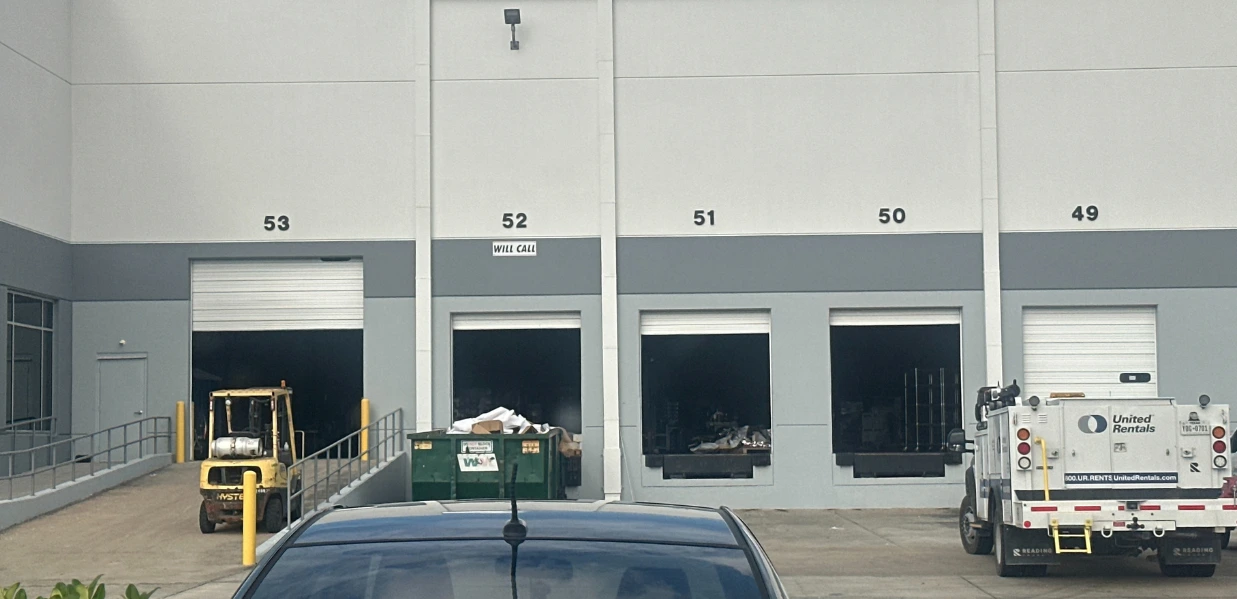
The investigation began at a large commercial warehouse complex in Pasadena. The target suite was not immediately identifiable from external observation, and the first day of surveillance focused on narrowing down the specific portion of the complex associated with the investigation by observing vehicle activity, entry points, loading dock usage, and the movement of personnel within the complex.
By mid-morning of day one, our investigators had confirmed the precise target location through a pretext entry into the facility. During the entry, our investigator made direct contact with a business partner who self-identified as one of the operation’s partners and provided substantive information about the facility’s layout and the scale of the business being conducted there. The business type confirmed during that first entry was directly relevant to the industry covered by the subjects’ non-compete agreements. The target facility was confirmed, the business type was established, and the investigation moved into its documentation phase.
External surveillance: documenting the subjects’ presence and activity
Across the full investigation window, our investigators documented the three subjects’ consistent presence at and participation in the daily operations of the Pasadena facility. Each of the three subjects was observed arriving at and entering the facility on multiple surveillance days. Their vehicles were documented with specificity, allowing our investigators to confirm their presence on days when direct visual identification was not possible from the surveillance position.
The external surveillance documented a commercially active facility receiving regular commercial deliveries including full truckload shipments arriving from multiple states, packaging and inventory operations being conducted by a workforce of employees, and the participation of all three subjects in executive-level activity at the facility including supervising operations, receiving visitors, and managing logistics. On August 31, one of the subjects was observed removing a long object of indeterminate type from a vehicle and returning it inside the facility; this observation was documented with the available level of visual confirmation and included in the report as observed.
A significant operational observation occurred on September 16, when one of the subjects was observed changing the license plate on a vehicle associated with the operation in the facility’s parking area. The plate change was documented in full including the original plate, the replacement plate, and the sequence of events surrounding the change. The reason for the change was not independently established, but the documented observation was included in the complete evidence file.
Undercover entries: establishing roles, business type, and interior operations
Our investigators conducted multiple undercover entries into the target facility across the investigation window, operating under a commercial cleaning services pretext that provided natural reasons for repeated contact with the facility’s management and sustained access to the interior of the operation.
Through these entries, our investigators established direct contact with two of the three subjects, obtained the subjects’ business email addresses, and observed the interior of the warehouse operation including inventory being packaged and organized, products consistent with the industry covered by the subjects’ non-compete agreements being received and processed, and the overall operational scale of the competing enterprise. One of the subjects confirmed his role as a business partner in the operation in direct conversation with our investigator. Another confirmed his supervisory responsibilities. The third subject was documented through external surveillance across multiple days, confirming his association with the facility and its operations.
The undercover entries produced business intelligence that external surveillance alone could not have established and gave our client’s attorney a documented record that included direct admissions by two of the three subjects about their roles in the competing operation.
What the investigation produced
Everything below was documented across the 25 surveillance days and appears in the report and evidence file delivered to our client.
- Target facility confirmed on day one. The specific suite and business type at the Pasadena warehouse complex were confirmed through a pretext entry on August 24, 2026, establishing the precise location and commercial activity associated with the investigation.
- All three subjects documented at the facility across multiple surveillance days. Each of the three former executives was observed arriving at and participating in the operations of the Pasadena facility across the investigation window, with vehicles and personal identifications documented for each.
- Business type confirmed as directly relevant to non-compete agreements. The commercial activity conducted at the target facility was confirmed to be of the same industry type covered by the subjects’ non-compete agreements, establishing the relevance of the documented activity to the client’s legal allegations.
- Direct role admissions obtained through undercover inquiry. Two of the three subjects made direct statements to our undercover investigator about their roles in the business operation, including a self-identification as a business partner by one subject and a confirmation of supervisory responsibilities by another.
- Active commercial operations documented across the full window. The investigation documented a fully operational commercial enterprise including employee workforces, regular inventory deliveries from multiple states, packaging and logistics operations, and executive-level management activity.
- License plate change documented. On September 16, one subject was observed and documented changing the license plate on a vehicle associated with the operation, with the complete sequence recorded.
- 846 photographic and video evidence files produced. The investigation produced a comprehensive evidentiary record across 25 surveillance days, covering the facility, its operations, the subjects’ presence and activities, vehicles, and all documented events of investigative significance.
HOW THE EVIDENCE HELPED
The documented record gave a specific factual foundation to pursue enforcement of the non-compete agreements rather than an allegation without evidence.
Non-compete enforcement in Texas requires more than a business owner’s belief that former executives are violating their agreements. It requires documented evidence of the specific activity prohibited under the agreements: the subjects’ participation in a competing operation, the nature of that operation, and the connection between the documented activity and the terms of the agreements being enforced. A business owner who brings a non-compete enforcement action without that documented foundation is bringing their own testimony against their former executives’ denials, and that is not a position from which enforcement is straightforward.
Our client’s attorney received a 25-day documented surveillance record covering every observed association between the three subjects and the competing Pasadena operation, the confirmed identity of the business type and its relevance to the non-compete agreements, direct admissions by two of the three subjects about their roles in the business, vehicle documentation confirming the subjects’ presence on days when personal identification was not directly possible, and a complete photographic and video evidence file covering the full operational window.
The investigation also produced something that is specific to a well-run undercover operation: contemporaneous documentation of what was actually happening inside the facility, gathered at the time it was happening, by investigators who were present in the space. That kind of documentation is categorically different from after-the-fact reconstruction and is correspondingly more difficult to challenge.
Our client had suspected what was happening. After the investigation, their attorney had a documented record of what was actually happening, in a form the legal system could work with.
THE RESULTS
Twenty-five surveillance days, and a complete documented record delivered to our client’s attorney.
The investigation covered the Pasadena facility from August 24 through September 18, 2026, across 25 surveillance days involving multiple investigators and a combined approach of external surveillance and undercover entries. The documented record established the target facility’s location and business type, confirmed all three subjects’ participation in the competing operation through direct observation and undercover contact, and produced 846 photographic and video evidence files organized for review by our client’s attorney.
Our client came to us with a concern they could not prove. They left with a documented investigation file that gave their attorney the specific factual foundation needed to pursue enforcement of the non-compete agreements through appropriate legal channels. What the investigation did was convert an allegation into a documented record. What happened next was their attorney’s domain.
Clarity begins with facts, not assumptions.
Why Choose Us
Seventeen years of documented casework. Founded in 2009, with more than eight hundred cases closed across Houston, Dallas, Austin, San Antonio, Miami, and Atlanta.
We work commercial and corporate cases with the same operational discipline as personal investigations. Non-compete investigations, business surveillance, and corporate intelligence matters require the same professional field craft as any other investigation, plus an additional layer of legal awareness about the commercial context in which the findings will be used. Our investigators are trained for both.
Undercover capability alongside external surveillance. External surveillance of a commercial facility tells you who comes and goes. Undercover entries tell you what is happening inside and what roles people are playing. Our investigators conduct undercover operations in commercial settings with the preparation and discipline that protects both the integrity of the investigation and the admissibility of what they learn.
Pasadena and Southeast Houston commercial surveillance experience. Our investigators have worked the Pasadena industrial corridor, Deer Park, La Porte, Baytown, and the surrounding southeast Houston commercial area. We know the operational environment and we know how to conduct sustained surveillance at commercial warehouse facilities without disrupting the investigation.
Reports structured for attorney use in commercial proceedings. Every finding is timestamped, organized by date and observation, and accompanied by a complete evidence log and investigator declaration. The report is structured for the attorneys and courts that will receive it, with the documented facts clearly distinguished from what could not be independently confirmed.
Licensed and accountable. Texas DPS License A30913601, with investigators operating across six metro markets.
If you believe former employees or executives are violating a non-compete agreement, the documented evidence to act on that belief has to be built by someone, and we build it.
If you are a business owner or attorney with reason to believe that former employees are operating a competing enterprise in violation of non-compete agreements, our investigators can build the documented record that gives the legal case a factual foundation. A confidential consultation costs you nothing.
Call (832) 404-3400 or submit your case below. We work with businesses and their attorneys and handle every inquiry with complete discretion.
getanswers@piterrance.com
piterrance.com/new-case-request/
Resources
Internal Resources
- Surveillance Investigations — How our surveillance operations are planned, executed, and documented for commercial and legal contexts.
piterrance.com/services/surveillance-investigations/ - Background Checks — How we verify identities and histories of individuals in commercial investigations and due diligence matters.
piterrance.com/services/background-checks/ - Who We Serve: Businesses — How we work with business clients on corporate surveillance, non-compete investigations, and commercial intelligence matters.
piterrance.com/who-we-serve/businesses/ - Who We Serve: Lawyers — How we work with attorneys on commercial surveillance documentation for business litigation and non-compete enforcement proceedings.
piterrance.com/who-we-serve/lawyers/ - Who We Serve: Individuals — Information for private clients commissioning commercial and business investigations.
piterrance.com/who-we-serve/individuals/ - Start Your Case
piterrance.com/new-case-request/
External Resources
- State Bar of Texas — Find a Lawyer — Search for licensed Texas attorneys in the Houston area specializing in business litigation, non-compete enforcement, and commercial disputes.
https://www.texasbar.com - Texas Business Organizations Code — The statutory framework governing business formation and obligations in Texas, relevant to the legal context of commercial disputes involving former executives.
https://statutes.capitol.texas.gov - Texas Attorney General — Consumer Protection and Business — Resources for reporting deceptive trade practices and unfair business conduct in Texas.
https://www.texasattorneygeneral.gov/consumer-protection - Better Business Bureau — Houston — Verification and dispute resources for commercial matters in the Houston area.
https://www.bbb.org/local-bbb/bbb-of-greater-houston-and-south-texas - Texas Department of Public Safety — Private Security Bureau — License verification and information on licensed private investigators in Texas.
https://www.dps.texas.gov/section/private-security
Frequently Asked Questions
What is a corporate surveillance investigation in Houston?
A corporate surveillance investigation in Houston is a professional field operation in which our investigators document the business activities, associations, and movements of individuals or entities relevant to a commercial dispute, including non-compete violations, theft of trade secrets, employee misconduct, and unauthorized competitive operations. The investigation combines external surveillance from lawful public vantage points with undercover inquiries where appropriate, producing a documented record that a client’s attorney can use in a legal proceeding.
How can a private investigator help with a non-compete violation case?
A private investigator can document whether a former employee or executive is actually engaged in the activities prohibited under their non-compete agreement, including their presence at a competing operation, their role within that operation, the nature of the business being conducted, and their associations with other individuals connected to the competing entity. The investigation produces a contemporaneous timestamped record that gives an attorney the documented factual foundation needed to pursue enforcement.
What does undercover investigation mean in a corporate surveillance context?
In a corporate surveillance context, an undercover inquiry involves our investigators entering a commercial facility or interacting with individuals associated with the target operation in a capacity other than as an identified investigator, in order to gather information not observable from external surveillance positions. In this case, our investigators entered the target facility under a business services pretext on multiple occasions, establishing direct contact with identified persons of interest and documenting their roles within the operation. All undercover activity was conducted within the bounds of Texas law.
What kinds of evidence does a corporate surveillance investigation produce?
A corporate surveillance investigation produces timestamped photographic and video documentation of the subjects’ presence and activities at the target location, vehicle and license plate documentation, identified contacts and associates, observed business activities including deliveries and inventory operations, and information obtained through lawful undercover inquiries including direct admissions by subjects regarding their roles in the business.
Can surveillance findings be used to enforce a non-compete agreement in Texas?
A professionally documented surveillance investigation that establishes a former executive’s participation in a competing operation provides an attorney with the factual foundation needed to pursue enforcement of a non-compete agreement in Texas court. Whether specific findings support enforcement depends on the terms of the agreement, the nature of the documented activity, and applicable Texas law. We recommend consulting with a Texas business attorney about how specific findings apply to your situation.
How do I start a corporate surveillance investigation with Terrance PI?
Call or text our team at (832) 404-3400, email getanswers@piterrance.com, or submit your case at piterrance.com/new-case-request/. We work with businesses and attorneys on corporate surveillance and non-compete investigations across Houston. We respond quickly and handle every inquiry with complete discretion.