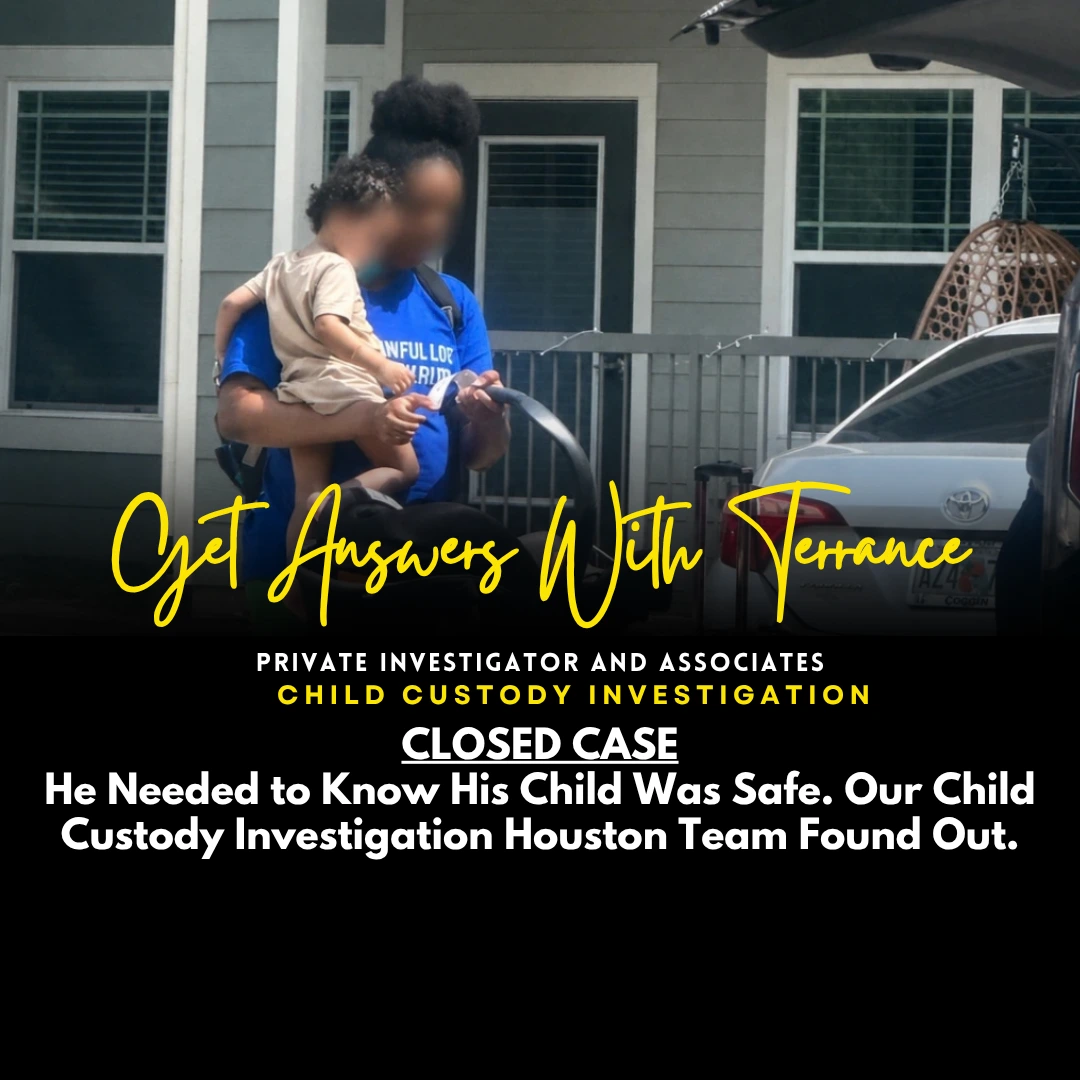

CASE OVERVIEW
Olivia was coming back from Keith’s place different. Shannon had been a mother long enough to know the difference between a child who had a hard weekend and a child who was not being looked after, and what she was seeing was not a hard weekend.
Sometimes professional surveillance is all our client needs but let us be clear about the position Shannon was in. She was not the custodial parent. Keith had custody of Olivia in Conroe, which meant that the daily decisions about Olivia’s life, the supervision, the environment, the people she was around, all of it was Keith’s domain. Shannon had her time with Olivia, and during that time Olivia was fine. It was what Olivia brought back with her that was the problem.
The signs were the kind that accumulate rather than announce themselves. Olivia coming back hungry in a way that went beyond missing lunch. Coming back in clothes that had not been washed. Coming back tired in a way that suggested she had not been sleeping properly, or that the environment she had been sleeping in was not what a child’s environment should be. Coming back with accounts of things she had seen and been around that Shannon could not verify but could not ignore.
Shannon had said something to Keith. Keith had said she was overreacting. Shannon had spoken to her attorney. Her attorney had told her what every family law attorney tells a parent in this position: what you are describing may well be true, but what you are describing is also testimony, and testimony from the other parent in a custody dispute is not the same thing as evidence. If Shannon wanted to do something about what was happening to Olivia at Keith’s residence in Conroe, she needed more than her word against his.
She came to Terrance Private Investigator and Associates. Our investigators went to Conroe and built the file that Shannon’s attorney needed.
Names have been changed, and this case study is published with permission.
THE CHALLENGE
The challenge in a neglect documentation case is that neglect is not a single dramatic event. It is a pattern, and a pattern requires multiple observations across time to establish, which is exactly what a professional investigation is designed to produce.
Parental neglect cases present a specific evidentiary challenge that distinguishes them from other custody investigations. In an infidelity case, a single documented occasion can be compelling. In a neglect case, a single occasion is not enough, because a single occasion can be explained away as an off day, a temporary lapse, or a misrepresentation by the investigating party. What a neglect case requires is a documented pattern: multiple observations across multiple days, consistent in their findings, that establish a recurring reality in a child’s life rather than an isolated incident.
Our investigators needed to document the actual conditions of Olivia’s daily life at Keith’s Conroe residence across the investigation window. That meant observing the supervision she was receiving, the environment she was living in to the extent observable from outside the residence, the individuals who were present and responsible for her care, the consistency of her routine, and any specific conditions or behaviors that would support Shannon’s concerns in a form a family court could consider.
Shannon had been watching this for months and had a clear picture of what she believed was happening. Our investigators needed to translate that picture into documented observations, because a court does not see what a mother sees. It sees what the record shows.
THE INVESTIGATION
Our investigators went to Conroe and watched. What they documented across the investigation window was a pattern of care, or rather the consistent absence of it.
The investigation covered Keith’s Conroe residence across the full operational window, documenting Olivia’s daily life and the actual conditions of her care under the existing custody arrangement. Here is what the documented record produced.
Supervision and who was actually responsible for Olivia
The first and most fundamental question in a neglect documentation investigation is who is actually supervising the child when the custodial parent is supposed to be doing so. Keith was the custodial parent. The question the investigation needed to answer was whether Keith was functionally present in Olivia’s daily life or whether her actual daily supervision was being provided by other people, in ways that raised legitimate concerns about her care.
Our investigators documented the pattern of supervision at Keith’s residence across the investigation window. What they observed was a child whose daily care was not consistently being provided by the custodial parent. The individuals responsible for Olivia on the occasions our investigators documented included people whose role in her life and whose suitability as caregivers presented concerns that were directly relevant to Shannon’s petition for modification. The documentation established not just that Keith was absent from Olivia’s daily supervision, but who was present in his place and what that presence looked like.
The conditions Olivia was living in
Our investigators documented observable conditions at and around Keith’s Conroe residence across the investigation window. The documentation covered the observable state of the residential environment, Olivia’s observable physical condition and presentation on the days she was seen, and any specific conditions or incidents that presented an observable concern for her wellbeing.
What the investigation documented was consistent with what Shannon had been describing: a child whose daily environment was not meeting the standard of care that a primary custody arrangement implies, across multiple documented occasions rather than a single instance that could be explained away as circumstantial.
The pattern Shannon had been watching and what it looked like in a file
Shannon had been watching Olivia come home for months and reading the signs in the way only a mother reads them. The investigation translated those months of maternal observation into a documented record: specific dates, specific observations, specific documented conditions, organized in the format that Shannon’s attorney could use in a family court proceeding to demonstrate that what Shannon had been saying was not testimony. It was a pattern, and the file showed it.
When Shannon received the report she said she had known all along. She said it was both a relief and a heartbreak to see it in a document, to have the thing she had been living with named and organized and real in a way that a court would have to reckon with. That is the particular weight of a neglect documentation case, and it is the weight our investigators carried carefully through every day of the investigation.
What the investigation produced
Everything below was documented across the operational period and appears in the report delivered to Shannon and her attorney.
- Supervision pattern documented. The actual pattern of supervision at Keith’s Conroe residence was documented across multiple days of the investigation window, establishing who was and was not providing consistent custodial care for Olivia during the periods covered.
- Caregiver identity and suitability documented. The individuals responsible for Olivia’s care in Keith’s absence were identified and documented, providing Shannon’s attorney with specific, named findings about who was supervising Olivia and under what circumstances.
- Observable conditions of care documented. The observable conditions of Olivia’s daily environment and physical presentation across the investigation window were documented in a form that supports Shannon’s account of the standard of care Olivia was receiving.
- Pattern established across the operational window. The documented findings were consistent across multiple observations during the investigation period, establishing a pattern of inadequate care rather than an isolated incident that could be characterized as exceptional or circumstantial.
- Complete timestamped report delivered. Shannon and her attorney received a professionally organized investigation report covering every documented finding, with timestamped observations and photographic evidence, structured for use in a custody modification proceeding in Texas family court.
HOW THE EVIDENCE HELPED
Shannon’s word against Keith’s was a tie. Shannon’s word plus a professionally documented investigation file was something very different.
Here is the reality of custody disputes in Texas family court: both parents typically present versions of the situation. The court is aware that both parents are interested parties. The court is aware that what one parent says about the other is filtered through a lens of conflict and competing interest. What a court responds to differently is a professionally documented record gathered by licensed investigators with no stake in the outcome, organized in a format the court can evaluate independently of what either parent is claiming.
Shannon’s concerns about Olivia’s care were legitimate and they were real. They were also, before the investigation, entirely dependent on Shannon’s testimony to establish. Keith could deny them, minimize them, explain them away, or simply assert a different version of events, and without a documented record, the court would be left choosing between two parents’ accounts of the same situation. The investigation changed that dynamic entirely. Shannon walked into the custody modification proceeding with a file that documented what was actually happening at Keith’s residence, on specific dates, in specific detail, gathered by investigators who had no relationship to either party and no motivation to misrepresent what they observed.
Olivia deserved to have someone document what her life actually looked like. Shannon’s job was to be her mother. Our job was to make sure the court could see what that mother had been seeing, and the file did that.
THE RESULTS
Shannon walked into the custody modification proceeding with documented evidence rather than a mother’s testimony. Olivia’s life in Conroe finally had a witness who could put it on paper.
The investigation produced a complete documented record of the conditions of Olivia’s care at Keith’s Conroe residence across the operational window, establishing a pattern of inadequate supervision and care through multiple timestamped observations and photographic evidence. Shannon’s attorney received a file organized for use in a Texas family court custody modification proceeding, with every finding documented in a form that does not require Shannon’s testimony to establish its credibility.
Shannon had known what was happening to her daughter. She had known it the way mothers know things, in the particular and irreplaceable way that a parent reads a child who cannot fully articulate what their daily life is like. What she had not had was the documented form of what she knew. The investigation gave her that. It gave her attorney that. It gave Olivia the possibility of a different arrangement, built on documented fact rather than one parent’s word against another’s.
Clarity begins with facts, not assumptions.
Why Choose Us
Seventeen years of documented casework. Founded in 2009, with more than eight hundred cases closed across Houston, Dallas, Austin, San Antonio, Miami, and Atlanta.
We document patterns, not incidents. A single observation does not establish neglect in a legal proceeding. Our investigators are trained to conduct multi-day custody investigations that build the documented pattern a family court needs to consider a custody modification, not just a single visit that can be explained away.
Conroe and Montgomery County surveillance experience. Our investigators have worked Conroe, The Woodlands, Willis, Montgomery, and the surrounding north Houston corridor extensively. We know the area and we know how to conduct residential surveillance in it without disrupting the operation.
Reports structured for family court use. Every finding is timestamped, organized by date and observation type, and structured specifically for the attorneys and courts that will receive them in Texas custody proceedings.
We understand what is at stake. A child custody investigation is not an abstract legal exercise. There is a child at the center of it. Our investigators conduct these cases with the seriousness that requires, and they document what they find completely and honestly regardless of which direction the findings point.
Licensed and accountable. Texas DPS License A30913601, with investigators operating across six metro markets.
Your child deserves to have what you have been seeing put on paper.
If you are a parent who believes your child is not being cared for properly under the current custody arrangement, and you need documented evidence rather than your word against theirs, our investigators are ready to listen. A confidential consultation costs you nothing and will tell you whether a professional investigation makes sense for your situation.
Call (832) 404-3400 or submit your case below. Everything you tell us stays between us.
getanswers@piterrance.com
piterrance.com/new-case-request/
Resources
Internal Resources
- Child Custody Investigations — How our investigators approach custody surveillance, neglect documentation, and parental fitness cases from intake to delivered report.
piterrance.com/services/custody-investigations/ - Surveillance Investigations — How our surveillance operations are planned, executed, and documented for residential and legal contexts.
piterrance.com/services/surveillance-investigations/ - Background Checks — How we verify the identities and backgrounds of individuals connected to a custody or neglect investigation.
piterrance.com/services/background-checks/ - Who We Serve: Individuals — Information for private clients navigating custody concerns, parental neglect, and domestic investigations.
piterrance.com/who-we-serve/individuals/ - Who We Serve: Lawyers — How we work with family law attorneys to produce custody and neglect documentation structured for Texas family court proceedings.
piterrance.com/who-we-serve/lawyers/ - Start Your Case
piterrance.com/new-case-request/
External Resources
- Texas Family Law Foundation — Resources and referrals for parents navigating Texas custody proceedings, modification hearings, and related family law matters.
https://www.txfamilylawfoundation.org/ - State Bar of Texas — Find a Lawyer — Search for licensed Texas family law attorneys in the Houston and Montgomery County area specializing in custody modification proceedings.
https://www.texasbar.com - Texas Attorney General — Child Support Division — Resources on custody orders, modifications, and enforcement in Texas family court.
https://www.texasattorneygeneral.gov/child-support - Texas DFPS — Child Protective Services — If you believe a child is in immediate danger, Texas DFPS Child Protective Services accepts reports of abuse and neglect.
https://www.dfps.texas.gov/Child_Protection/About_Child_Protective_Services/ - Psychology Today — Find a Therapist — Search licensed counselors in the Houston and Conroe area specializing in child trauma, co-parenting conflict, and custody-related stress.
https://www.psychologytoday.com/us/therapists
Frequently Asked Questions
What is a parental neglect documentation investigation in Texas?
A parental neglect documentation investigation in Texas is a professional surveillance and records operation in which our investigators observe and document the actual conditions of a child’s care under the custodial parent across a defined operational window. The objective is to produce a complete, timestamped, professionally organized record that establishes the factual basis for a custody modification proceeding based on observable neglect rather than one parent’s unverified account of the other.
What kinds of neglect can a custody investigation document?
Our investigators can document a wide range of observable neglect conditions including failure to supervise a child adequately, leaving a child in the care of inappropriate individuals, failure to maintain safe and appropriate living conditions, substance use in the presence of a child, failure to meet a child’s medical or educational needs, and other conditions that present an observable risk to a child’s safety or wellbeing. The investigation documents what can be observed and confirmed during the operational window.
How does a professional investigation differ from my own observations?
Your own observations, however accurate, are testimony. A professional investigation produces a timestamped documented record gathered by licensed investigators operating through legal surveillance methods, supported by photographic evidence, and organized for use in a legal proceeding. In a custody dispute, the difference between a parent’s testimony and a professionally documented investigative file is the difference between what one party says and what the documented record shows.
Can a custody investigation be used to modify an existing custody order?
Yes. A professionally documented investigation that establishes observable neglect, safety concerns, or a pattern of parenting behavior inconsistent with the child’s best interest provides an attorney with the factual foundation needed to petition for a custody modification in Texas family court. The documented record supplements and supports the legal argument rather than replacing the attorney’s role in the proceeding.
What if the other parent knows I am concerned and changes their behavior temporarily?
Temporary behavioral changes in response to perceived scrutiny are common and do not necessarily prevent a professional investigation from producing useful documentation. Our investigators document what is actually observable across the full operational window, and a pattern of neglect that has been ongoing for months does not typically disappear cleanly when a parent becomes aware that scrutiny may be coming. We assess each case at intake and give every client an honest account of what the investigation can realistically produce.
How do I start a child custody investigation with Terrance PI?
Call or text our team at (832) 404-3400, email getanswers@piterrance.com, or submit your case at piterrance.com/new-case-request/. We respond quickly and handle every inquiry with complete discretion. If you are a parent who believes your child is not being cared for properly under the current custody arrangement, we are ready to listen.