
CASE OVERVIEW
Our client had not seen her husband in three days. She came to us, and our infidelity investigation began, finding him the first night.
There is a particular kind of investigation that begins not with a specific location to surveil, but with a person who has to be found before they can be followed. Our client’s husband had been absent from home for three days without a credible account of where he was staying or what he was doing. Our client had access to some of his financial transaction data and had information from family members about where he might be, but she had no confirmed location, no reliable schedule, and no way to establish where to begin.
She came to Terrance Private Investigator and Associates. She told our team what she knew: the last location where her husband’s debit card had been used, the areas of Houston where he might be staying, and the general geography of where she believed he was spending his time. Our investigators began a locate operation in Houston’s Galleria and Westheimer corridor, canvassing hotels, checking known establishments, and following the financial transaction trail in real time as our client provided updates from the associated account.
On the first evening of the investigation, our investigators located our client’s husband at an entertainment venue on Richmond Avenue. They documented what they found with the specificity and honesty that professional field surveillance requires, including the limitations of what could be photographed in the low-light environment and the portions of the evening that could not be observed due to restricted access. Our client received the complete documented account of what our investigator directly observed.
All parties are fully anonymized. This case study is published with permission.
THE CHALLENGE
There is no fixed surveillance point to establish, no known schedule to work from, and no residence or workplace to anchor the operation.
Our investigators began with what our client could provide. The last location where the subject’s debit card had been used gave a geographic starting point. Known family information suggested the subject might be staying in a hotel somewhere in the Galleria area. The subject’s general habits gave our investigators a set of establishments likely to be relevant to his whereabouts during the investigation window.
What made this investigation operationally demanding was that it required continuous active canvassing rather than stationary surveillance. Our investigators could not establish a position and wait for the subject to appear at a known location, because the subject’s location was exactly what the investigation was trying to establish. The canvass covered hotels, known venues along the Richmond Avenue and Westheimer corridors, and any location to which the client’s real-time financial information pointed during the operation.
Our investigators also had to work with the specific limitations of the venue where they ultimately found the subject. Low lighting conditions inside the establishment prevented photographs from being obtained during the surveillance period. A restricted access area within the venue prevented direct observation of a portion of the evening’s activity. Both limitations are documented in the report honestly, because a client who receives an incomplete account of what the investigation could and could not establish makes decisions on an incomplete foundation.
THE INVESTIGATION
Three days surveillance, one location, and one documented encounter between the subject and an identified woman.
The investigation ran across three operational days: October 4, 5, and 6, 2026. Here is what each phase produced.
October 4: the locate operation and what our investigator found
Our investigator began the locate operation at the hotel where the subject’s debit card had last been used. The subject’s vehicle was not present. Our investigator then canvassed hotels across the Galleria and Memorial City areas, checking locations along Beltway 8, Westheimer Road, and Richmond Avenue. The subject’s vehicle was not located during the afternoon canvass.
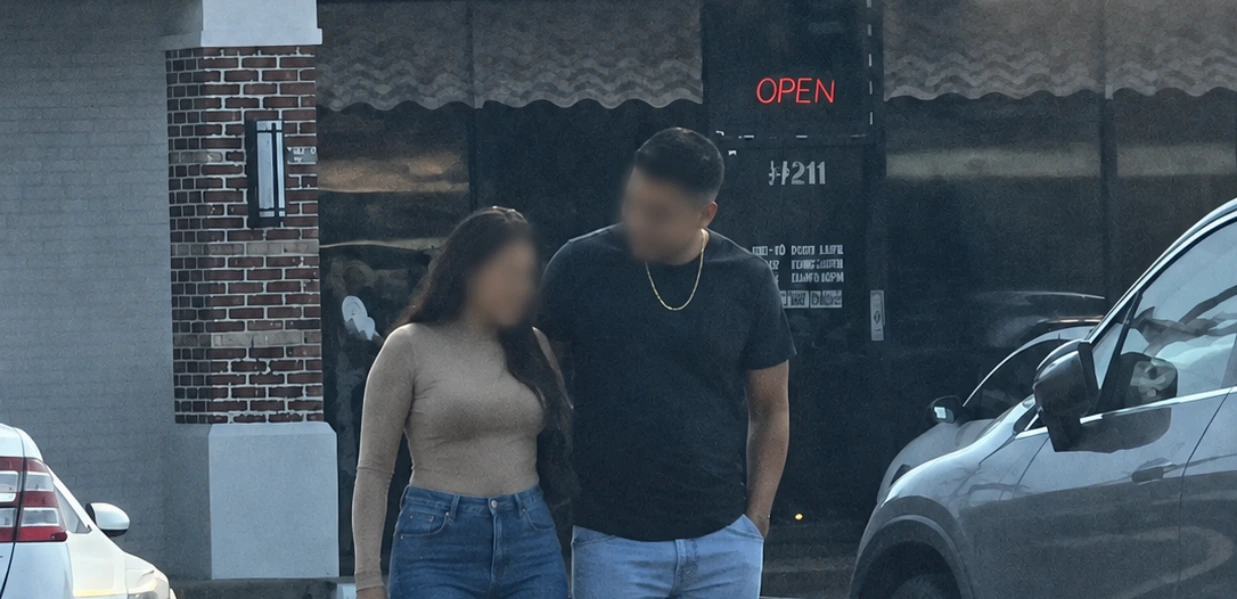
At approximately 9:05 PM, our investigator entered an entertainment venue on Richmond Avenue and located the subject inside. The subject was seated in a booth with a woman our investigator observed at close range. Our investigator documented the following, based on direct visual observation during the surveillance period.
The subject and the woman were seated in close physical proximity. The subject placed his arm around her. Both individuals were observed leaning closely toward one another during their interaction. Their physical proximity and observed behavior were consistent with an intimate or affectionate interaction rather than a casual social encounter. The low-light conditions inside the venue prevented photographs from being obtained; the investigator’s observations are based on direct firsthand surveillance at close range.
During the evening, the subject made a purchase at the venue totaling approximately six thousand dollars. Following this transaction, the subject and the woman were escorted together to a restricted upstairs area of the establishment. Our investigator was unable to maintain direct visual surveillance of that area due to restricted access. The activities occurring in the private area could not be observed or documented.
At approximately 10:10 PM, the subject and the woman exited the establishment together. The subject departed in a vehicle believed to be a rideshare service. The woman departed in her personal vehicle, traveling in the same direction as the vehicle transporting the subject. Their subsequent destination and whether they met again at another location could not be established through surveillance.
October 5: extensive canvassing and the rental vehicle lead
On October 5, our investigator returned to the subject’s last confirmed location and conducted an extensive canvass of the Galleria area, checking approximately twenty hotels in an attempt to relocate the subject or his vehicle, and neither was found. Our investigator also returned to the venue from the previous evening and checked an additional establishment in the area. The subject was not located.
During the afternoon, our client provided information from family members suggesting the subject might be staying at a specific hotel. Our investigator checked that location and an adjacent hotel. The subject was not found at either. Our investigator also canvassed additional entertainment venues in the area. The subject was not located.
Later that evening, our client advised that a charge had appeared on the associated account from a rental car company. The specific location of the transaction could not be identified at that time, which prevented our investigators from acting on the lead directly. Our investigators continued the canvass through the evening without relocating the subject.
October 6: rental vehicle intelligence and continued canvass
On October 6, our client provided updated information suggesting the subject might be staying at a specific hotel near the Post Oak area and was believed to be operating a rented black Buick. Our investigator checked the identified hotel, searching specifically for the rental vehicle. Neither the vehicle nor the subject was located.
Our investigator then checked additional entertainment venues along the Westheimer corridor and the surrounding area. The subject was not located at any of these establishments. Our client subsequently provided information that the subject had made an ATM withdrawal in a nearby area. Our investigator responded to that location and canvassed the surrounding streets and establishments. The subject was not located.
Surveillance was concluded on October 6 without the subject being relocating following the October 4 sighting.
What the investigation produced
Everything below was documented across the three operational days and appears in the report delivered to our client.
- Subject located on the first evening of the investigation. Our investigator located the subject at an entertainment venue on Richmond Avenue on October 4, 2026, after conducting a canvass of the Galleria and Westheimer corridor.
- Subject documented in the company of an identified woman. The subject was observed seated in a booth with a woman identified by our investigator at close range. Her identity was established during the surveillance period.
- Intimate or affectionate interaction documented by direct observation. Our investigator directly observed the subject placing his arm around the woman, both individuals in close physical proximity, and behavior consistent with an intimate or affectionate encounter rather than a casual social interaction. No photographs were obtained due to lighting conditions; the finding is based on firsthand investigator observation.
- Significant financial transaction documented. The subject made a purchase at the venue totaling approximately six thousand dollars during the surveillance period.
- Joint departure documented. The subject and the woman were observed exiting the establishment together at approximately 10:10 PM. The subject departed in a rideshare vehicle and the woman departed in her personal vehicle, traveling in the same direction.
- Restricted area limitation documented honestly. The subject and the woman were escorted to a restricted upstairs area of the venue following the financial transaction. Our investigator was unable to observe activity in that area due to restricted access, and this limitation is documented specifically in the report.
- 34 photographic evidence files produced. The investigation produced 34 photographic files across the three operational days, covering the venue, the subject’s associated vehicles and locations, and the surveillance canvass.
HOW THE EVIDENCE HELPED
After the investigation, she knew exactly where he had been, who he had been with, and exactly what a six-thousand-dollar evening at an entertainment venue looked like.
The investigation did not produce a photograph. It did not establish what happened in the restricted upstairs area. It did not relocate the subject on October 5 or October 6. What it produced was a firsthand investigator observation of our client’s husband in the company of another woman, behaving in a way that was documented as intimate or affectionate in nature, at a specific venue, on a specific evening, following a financial transaction of a specific and significant amount.
Our client had not known where he was. After October 4, she knew where he had been and what she was dealing with. The investigation also produced something that matters in the context of a marriage and any potential legal proceeding that follows from it: a firsthand observation by a licensed independent investigator, documented in a professional report, that is not dependent on our client’s testimony or her husband’s denial for its credibility. What our investigator saw, our investigator saw. The report states what was observed, what was not observed, and what could not be established, completely and honestly.
Our client had three days of questions with no answers. She left the investigation with documented answers to the most specific question the investigation was positioned to answer: was her husband with another woman, and how was he spending the money in the account she had access to? The investigation answered both of them.
THE RESULTS
Three days unaccounted for, located on night one, six thousand dollars at a venue on Richmond Avenue, a documented encounter with an identified woman, and a client who finally knew what she needed to know.
The investigation located the subject on the first operational evening after a multi-hour canvass of Houston’s Galleria corridor. The documented findings from October 4 included a firsthand observation of the subject with an identified woman, documented intimate or affectionate behavior, a six-thousand-dollar financial transaction, and a joint departure from the establishment. The investigation did not establish the subject’s whereabouts after that evening, and two additional days of canvassing did not produce a second documented sighting.
Our client came to us not knowing where her husband was or what he was doing. She left the investigation knowing what had happened on the first night our investigators looked for him. The documented file gave her the factual foundation she needed to make decisions about her marriage and any legal steps that might follow from those decisions.
Clarity begins with facts, not assumptions.
Why Choose Us
Seventeen years of documented casework. Founded in 2009, with more than eight hundred cases closed across Houston, Dallas, Austin, San Antonio, Miami, and Atlanta.
We locate subjects, not just surveil them. Not every infidelity investigation begins at a known address with a subject whose schedule can be established in advance. Some investigations begin with a husband who has been absent for three days and a wife who does not know where to look. Our investigators are trained in locate operations that combine field canvassing, real-time client intelligence, and knowledge of Houston’s geography to find subjects who are not where they are supposed to be.
We document what we observe and say clearly what we could not. The limitation in this case, the inability to photograph due to poor lighting and the restricted access area, is documented in the report. Our clients receive the complete account of the investigation, including what could be established and what could not, because a client who makes decisions based on a partial picture makes decisions on a flawed foundation.
Houston Galleria and Westheimer corridor experience. Our investigators know the Richmond Avenue and Westheimer corridors, the Galleria area hotel landscape, and the entertainment venue geography of southwest Houston. We know how to conduct a locate canvass in this part of the city efficiently and how to work the specific operational challenges of surveillance in venues where photography is difficult.
Real-time client collaboration during the investigation. In this case, our client provided real-time financial transaction information and family intelligence during the operation that directed our investigators toward specific locations and leads. Our investigators incorporated that information as it arrived and acted on it in the field. Clients who can provide real-time information during an investigation make the investigation more responsive and more effective.
Licensed and accountable. Texas DPS License A30913601, with investigators operating across six metro markets.
If your spouse is unaccounted for and you need to know where they are, we can look.
If your spouse or partner has been absent without a credible explanation, if something does not add up about where they say they are and what you are seeing in your shared accounts, or if you simply need to know what is actually happening, our investigators can help. A confidential consultation costs you nothing.
Call (832) 404-3400 or submit your case below. Everything you tell us stays between us.
getanswers@piterrance.com
piterrance.com/new-case-request/
Resources
Internal Resources
- Infidelity Investigations — How our investigators approach cheating spouse surveillance and locate operations from intake through delivered report.
piterrance.com/services/infidelity-investigations/ - Surveillance Investigations — How our surveillance operations are planned, executed, and documented across Houston and surrounding markets.
piterrance.com/services/surveillance-investigations/ - Background Checks — How we verify identities and histories for clients navigating domestic investigations.
piterrance.com/services/background-checks/ - Who We Serve: Individuals — Information for private clients navigating infidelity concerns, locate operations, and domestic investigations.
piterrance.com/who-we-serve/individuals/ - Who We Serve: Lawyers — How we work with family law attorneys on surveillance documentation for divorce and related proceedings.
piterrance.com/who-we-serve/lawyers/ - Start Your Case
piterrance.com/new-case-request/
External Resources
- Affair Recovery — Resources for individuals navigating suspected or confirmed infidelity and the decisions that follow.
https://www.affairrecovery.com/ - Psychology Today — Find a Therapist — Search licensed counselors in the Houston area specializing in relationship concerns, trust, and marriage decisions following infidelity.
https://www.psychologytoday.com/us/therapists - American Association for Marriage and Family Therapy — Find a licensed therapist specializing in marital concerns, trust, and relationship decisions following infidelity investigations.
https://www.aamft.org/Directories/Find_a_Therapist.aspx - State Bar of Texas — Find a Lawyer — Search for licensed Texas family law attorneys if investigation findings inform decisions about the future of the marriage.
https://www.texasbar.com - Texas Law Help — Divorce — Plain-language resources on divorce in Texas, including community property and fault-based divorce, if investigation results inform decisions about the marriage.
https://texaslawhelp.org/article/divorce-in-texas
Frequently Asked Questions
Can a private investigator help locate a spouse who has gone missing or is unaccounted for?
Yes. Our investigators can conduct a locate operation using the subject’s last known locations, financial transaction data provided by the client, known associates and frequented establishments, and field canvassing across the relevant area to establish visual contact with the subject and their vehicle. In this case, our investigators located the subject on the first evening of the investigation after conducting a canvass of Houston’s Galleria and Westheimer corridor.
What happens when a surveillance investigation locates a subject in a location where photographs cannot be obtained?
Our investigators document what they directly observe, including the individuals present, their interactions, their observable behavior, and any activity of investigative significance, even in conditions where photography is not possible. In this case, poor lighting conditions inside the establishment prevented photography. The investigator’s direct visual observations, including the subject’s identity, the identity of the person accompanying him, the nature of their observed interactions, and subsequent activity, are all documented in the report as firsthand investigator observations.
What does a partial-findings infidelity investigation result mean?
A partial-findings result means the investigation documented specific observations relevant to the client’s concerns without establishing every element the client may have sought to confirm. In this case, the investigation documented the subject’s presence with another individual, the intimate or affectionate nature of their observed interactions, a significant financial transaction, and their joint departure from the establishment. The documented observations are specific, firsthand, and real, regardless of what the investigation was unable to confirm.
Can financial transaction information be used to help locate a subject during an investigation?
Yes. When a client has access to financial account information for the subject, transaction data such as debit card or ATM activity can help our investigators narrow the geographic area of the search. In this investigation, the client provided real-time information about the subject’s financial transactions during the operational period, which directed our investigators toward specific areas and establishments during the canvass.
How does a locate and surveillance investigation work in Houston?
A locate and surveillance investigation combines field canvassing of the subject’s known or likely locations with traditional surveillance once contact with the subject is established. Our investigators begin with the last known location and work outward using whatever information the client can provide about the subject’s habits, associates, frequented establishments, and financial activity. Once the subject is located, surveillance focuses on documenting their activity, associations, and interactions across the operational window.
How do I start an infidelity investigation with Terrance PI?
Call or text our team at (832) 404-3400, email getanswers@piterrance.com, or submit your case at piterrance.com/new-case-request/. We respond quickly and handle every inquiry with complete discretion.