The arrangement had seemed straightforward when it started. Diane lived in Cypress and helped support an elderly parent who needed daytime care. Curtis was a family member, and family members stepping into care arrangements are common enough that the setup did not raise any flags at the beginning. Curtis was expected to arrive during agreed daytime hours, remain available to provide care, and be reachable while the arrangement was active. Diane was paying a set monthly amount for exactly that.
The problem was that Diane had no reliable way to confirm whether what she was paying for was actually happening. She was not present during the care hours. She relied on Curtis being where Curtis was supposed to be, doing what Curtis was supposed to be doing, during a window of time that Diane could not personally observe. For a while, that arrangement ran on trust. Then the trust started developing cracks.
The calls went unanswered during expected care hours, six rings with no answer, and not just once but repeatedly. Curtis had explanations, but the explanations did not hold together consistently across multiple conversations, and the reported daily routine did not align with what Diane knew from other sources about where Curtis actually was during those hours. None of it was enough to prove anything. All of it was enough to make Diane certain that something was not right.
Diane came to Terrance Private Investigator and Associates. She told our surveillance investigation team what she had been experiencing and what she needed: not a confrontation, not an accusation, not a dramatic intervention in a family arrangement. A documented record of what was actually happening during paid care hours so that she had something factual to stand on. Our investigators went to Cypress and built that record.
Names have been changed, and this case study is published with permission.
THE CHALLENGE
Six unanswered calls are a detail. A collection of inconsistent explanations is a concern. Neither one is a documented finding, and a documented finding was what Diane needed.
The challenge Diane faced is one that comes up in paid care arrangements more often than most families want to acknowledge. The person paying for care is typically not present during care hours. That is the whole point of the arrangement. Which means the person paying has no direct way to verify that the care they are paying for is being delivered, and the person providing care has a significant opportunity to claim hours they are not working without immediate detection.
Missed calls could have innocent explanations: a phone left in another room, an unusual day, a caregiver attending to the care recipient in a way that made them temporarily unreachable. A single inconsistency is not a finding. Even several inconsistencies, without a documented pattern to place them in, are difficult to act on. Diane could not raise the concern with Curtis based on feelings. She could not present the situation to an attorney based on recollection. She could not make a decision about the care arrangement based on a collection of unanswered calls and explanations that did not quite add up.
What she needed was a documented pattern, and a pattern requires multiple observations across a defined window to establish. Our investigators also had to work within clear legal limits. They could not enter private property. They could not record private conversations. They could not access Curtis’s phone or accounts. The investigation had to document what was lawfully observable from public vantage points and produce a record that was clean enough to be reviewed by Diane’s attorney without any evidentiary problems created by how it was gathered.
The question our investigators needed to answer was specific: was Curtis arriving as expected, remaining in the area during claimed care hours, and doing so consistently across the operational window? That question, answered with timestamped documented evidence, was what Diane came to us for.
THE INVESTIGATION
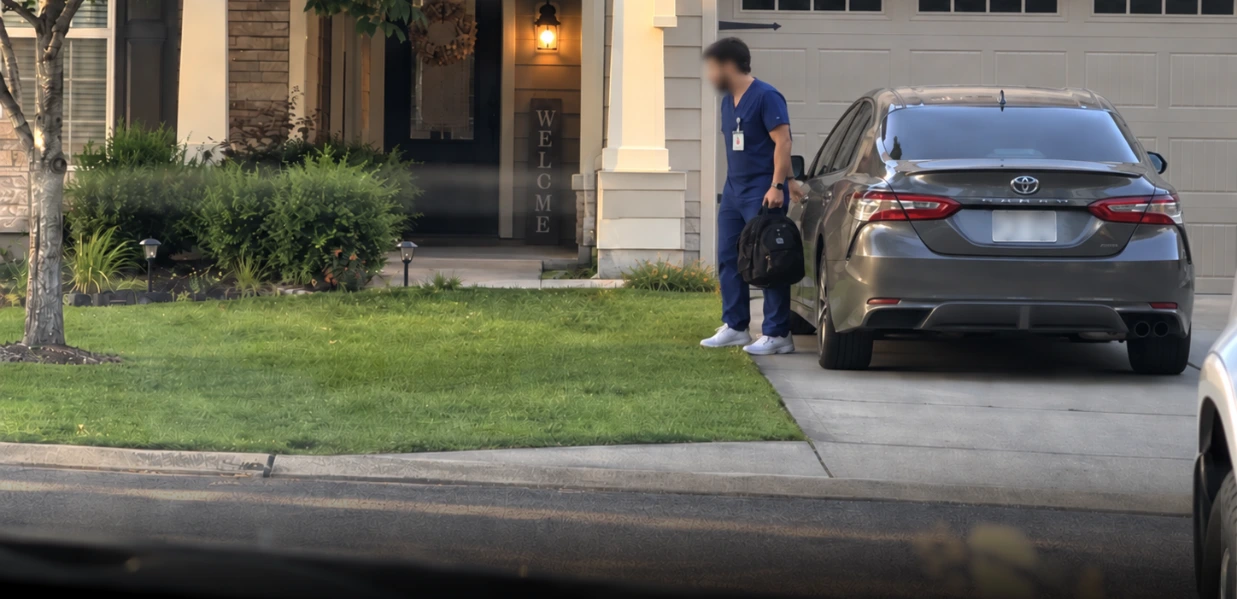
Our investigators went to Cypress and watched the actual care schedule across the operational window. What they documented was a pattern of deviations from the arrangement Diane was paying for.
The investigation covered the defined care window across Cypress, documenting Curtis’s actual arrivals, departures, and activity during the hours the care arrangement specified. Here is how the investigation was structured and what it produced.
Establishing the baseline routine first
Before our investigators could document deviations, they needed to establish what Curtis’s ordinary routine actually looked like during the care window. A late arrival is only meaningful if investigators can show it is late relative to a consistent established pattern rather than a schedule that varied day to day. A missed day is only significant if investigators can show that arrival on that day was expected and normal rather than optional.
Our investigators spent the initial period of the investigation documenting Curtis’s routine across the care window: the typical arrival time, the general timing of departures, and the observable activity during the hours the arrangement covered. That baseline gave the rest of the investigation a comparison point. Every subsequent observation could be measured against what was documented as Curtis’s ordinary pattern rather than against Diane’s expectations alone.
Documenting the deviations across the operational window
Once the baseline was established, the pattern of deviations became visible and documentable. Our investigators observed and recorded Curtis arriving late during expected care hours on repeated occasions. They documented days on which Curtis did not arrive at all during the scheduled window. They documented periods during which Curtis was observed elsewhere during claimed caregiving hours.
Each observation was recorded with the date, the time, the circumstances, and photographic documentation where operational conditions permitted. Our investigators did not rely on a single unusual day. One unusual day has too many possible explanations to stand as a finding. An emergency, a scheduling error, a circumstance Diane was not aware of, any of these could account for a single deviation. The investigation documented the same type of deviation recurring across the operational window, which is a different evidentiary picture entirely.
Organizing the documented record for Diane and her attorney
At the conclusion of the fieldwork, our investigators prepared a complete, professionally organized report covering every documented observation across the operational window. The report included timestamps, investigator notes, photographic documentation, and a clear account of the sequence of events across each day covered.
The report was organized to preserve the distinction between what our investigators directly observed and what the documented pattern reasonably indicated, without overstating what the evidence showed or claiming knowledge of what was happening inside the private residence during observed absences. Diane received a report that she and her attorney could read, evaluate, and use as a factual foundation for whatever decision or proceeding came next. Our investigators documented what they observed. The interpretation of what to do with that documentation was Diane’s to make from an informed position.
What the investigation produced
Everything below was documented across the operational window and appears in the report delivered to Diane.
- Baseline routine established. Our investigators documented Curtis’s ordinary arrival and departure pattern during the care window across the initial period of the investigation, providing a consistent comparison point for subsequent observations.
- Repeated late arrivals documented. Curtis was observed arriving late during expected daytime care hours on multiple occasions across the operational window, with each late arrival recorded by date, time, and circumstances.
- Missed days documented. Curtis was documented failing to arrive at all during the scheduled care window on certain days, with each missed day recorded with the same specificity as observed arrivals.
- Time spent elsewhere during claimed care hours documented. On multiple occasions, Curtis was observed at locations other than the care residence during the hours the arrangement covered, with each observation timestamped and documented.
- Pattern established across the full operational window. The documented findings were consistent across multiple observations throughout the investigation period, establishing a recurring pattern rather than isolated incidents that could be explained away individually.
- Complete report delivered for review by Diane and counsel. Diane received a professionally organized investigation report with timestamps, photographic documentation, investigator notes, and observations organized for personal review and potential use by her attorney in a family or legal proceeding.
HOW THE EVIDENCE HELPED
Diane had fragments before the investigation. She had a documented record after it. Those are two different things, and the difference is what allowed her to do something about the situation she had been living with.
Before the investigation, Diane had exactly the kind of evidence that goes nowhere: a collection of missed calls, a set of inconsistent explanations, and a sense that the schedule her elderly parent was supposed to be on was not being kept. All of that was real. None of it was documented in a form she could show to anyone who was not already inclined to believe her. A family member who denies missing care hours is hard to contradict with a memory of unanswered calls. An attorney who needs something to work with cannot build a case on a client’s recollection of explanations that did not add up.
The investigation converted what Diane had been experiencing into a documented record. Not a record of everything that happened inside the private residence during Curtis’s absences, since surveillance conducted from lawful public vantage points cannot document that, and our report was honest about what it could and could not establish. A record of what was observable: when Curtis arrived, when Curtis did not arrive, where Curtis was during the hours the arrangement covered, and the fact that this pattern repeated consistently across the operational window rather than appearing as a single unusual week.
That record gave Diane’s attorney something to work with. It gave Diane a factual foundation for a direct conversation about the care arrangement that did not depend on her memory against Curtis’s denials. It gave her elderly parent the documented basis for a change in the care situation that the facts had justified and the evidence could now support. Finding information on your own is possible. Confirming it in a form that holds up is the actual work, and that is what the investigation did.
THE RESULTS
The investigation established that Curtis’s actual routine did not match the care schedule Diane was paying for. Diane received a complete documented record that gave her something to act on rather than something to worry about.
The report covered the full operational window and documented a consistent pattern: repeated late arrivals during expected care hours, days with no arrival during the scheduled window, and time spent elsewhere during claimed caregiving hours. The pattern was documented across multiple observations with timestamps, photographs, and investigator notes organized for Diane’s personal review and for potential review by her attorney.
The case did not rest on a single photograph or one unusual afternoon. It rested on the consistency of the documented pattern across the full operational window, which is what a professional investigation is designed to establish. Diane walked out with a documented file rather than a collection of concerns. Her attorney had something to work with. The care arrangement had a factual record attached to it that no one could contradict with a verbal explanation.
Clarity begins with facts, not assumptions.
Why Choose Us
Seventeen years of documented casework. Founded in 2009, with more than eight hundred cases closed across Houston, Dallas, Austin, San Antonio, Miami, and Atlanta.
We document patterns, not incidents. A single missed day does not establish a pattern. A single unanswered call does not establish negligence. Our investigators are trained to build multi-observation investigations across a defined operational window that produce a documented pattern a client and their attorney can actually use, not a single finding that a subject can explain away.
We work within the legal limits and say so plainly. Our investigators do not enter private property, record private conversations, access accounts, or conduct surveillance through any method prohibited under Texas law. We document what is lawfully observable, we organize it clearly, and we tell clients honestly what the investigation can and cannot establish before the work begins.
Cypress and northwest Houston surveillance experience. Our investigators have worked Cypress, Katy, Spring, Tomball, and the surrounding northwest Houston corridor extensively. We know how to conduct residential surveillance in suburban Cypress without disrupting the operation or alerting the subject.
Reports organized for attorney review. Every finding is timestamped, organized by date and observation, and structured specifically for the attorneys and courts or family proceedings that may receive them. Whether specific evidence is ultimately useful in a legal proceeding is a question for the client’s attorney. Our job is to make sure the documented record is complete, honest, and organized well enough that the attorney can make that determination clearly.
Licensed and accountable. Texas DPS License A30913601, with investigators operating across six metro markets.
If you are paying for care you cannot verify, a professional investigation can tell you what is actually happening.
If you are in a paid care arrangement and you cannot confirm that the care you are paying for is being delivered, our investigators can document the actual pattern of activity during the care window from lawful public vantage points. A confidential consultation costs you nothing and will tell you honestly whether a professional investigation makes sense for your situation.
Call (832) 404-3400 or submit your case below. Everything you tell us stays between us.
getanswers@piterrance.com
piterrance.com/new-case-request/
Resources
Internal Resources
- Surveillance Investigations — How our surveillance operations are planned, executed, and documented for personal and legal contexts.
piterrance.com/services/surveillance-investigations/ - Background Checks — How we verify identities and backgrounds for clients commissioning caregiver and family investigations.
piterrance.com/services/background-checks/ - Who We Serve: Individuals — Information for private clients navigating caregiver concerns, family disputes, and domestic investigations.
piterrance.com/who-we-serve/individuals/ - Who We Serve: Businesses — How we work with business clients on documentation and activity investigations.
piterrance.com/who-we-serve/businesses/ - Who We Serve: Lawyers — How we work with attorneys on surveillance documentation for family and civil proceedings.
piterrance.com/who-we-serve/lawyers/ - Start Your Case
piterrance.com/new-case-request/
External Resources
- Texas Department of Family and Protective Services — Adult Protective Services — If you believe an elderly or vulnerable adult is being neglected or abused, Texas DFPS Adult Protective Services accepts reports and can conduct an investigation independent of private surveillance.
https://www.dfps.texas.gov/Adult_Protection/ - Texas Department of Public Safety — Private Security Bureau — License verification and information on licensed private investigators in Texas.
https://www.dps.texas.gov/section/private-security - State Bar of Texas — Find a Lawyer — Search for licensed Texas attorneys in the Houston and Cypress area specializing in elder law, family law, and civil matters related to caregiver disputes.
https://www.texasbar.com - Texas Penal Code Chapter 16 — Unlawful Use of Criminal Instrument or Mechanical Security Device — The Texas statutes governing tracking devices, interception of communications, and related surveillance restrictions relevant to lawful private investigation in Texas.
https://statutes.capitol.texas.gov/Docs/PE/htm/PE.16.htm - Eldercare Locator — U.S. Administration on Aging — National resource for connecting older adults and their families with local support services, including care oversight and adult protective services referrals.
https://eldercare.acl.gov/
Frequently Asked Questions
Can a surveillance investigation document whether a paid caregiver is following their schedule?
Yes. Our investigators can document a caregiver’s arrivals, departures, and observable activity during expected care hours from lawful public vantage points across a defined operational window. The investigation documents what is observable and legally confirmable through field surveillance, including late arrivals, missed days, and time spent away from the care location during claimed working hours.
Why is a professional investigation more useful than monitoring a caregiver yourself?
A professional investigation produces a timestamped, photographically documented record gathered by licensed investigators operating from lawful vantage points. Personal monitoring produces your own observations, which are difficult to document contemporaneously and may create conflict with the caregiver or other family members. A professionally organized report can be reviewed by an attorney, presented in a legal or family proceeding, and evaluated independently of either party’s account of the situation.
What is a baseline and why does a caregiver investigation need one?
A baseline is the documented record of a subject’s ordinary routine during the early period of an investigation. In a caregiver investigation, establishing the baseline first means that later deviations can be evaluated against what is normal rather than presented as isolated incidents. A deviation only has investigative meaning when there is an established pattern to deviate from.
What are the legal limits of a caregiver surveillance investigation in Texas?
Our investigators work exclusively from lawful public vantage points. They do not enter private property without authorization, record private conversations, access phones or accounts, or engage in any surveillance method prohibited under Texas law, including Chapter 16 of the Texas Penal Code. Every observation is gathered legally and documented in a form that can be reviewed by the client’s attorney.
Can a caregiver investigation report be used by an attorney?
A professionally organized surveillance report with timestamps, photographs, observations, and investigator notes is structured for review by counsel and potential use in a legal or family proceeding. Whether specific findings are admissible or useful in a particular proceeding is a legal question for the client’s attorney. Our investigators document what they observe completely and honestly so that the client’s attorney can evaluate the material on its own merits.
How do I start a caregiver surveillance investigation with Terrance PI?
Call or text our team at (832) 404-3400, email getanswers@piterrance.com, or submit your case at piterrance.com/new-case-request/. If you are paying for care you cannot verify, we can tell you whether a professional investigation makes sense for your situation. We respond quickly and handle every inquiry with complete discretion.