
How to Hire a Missing Person Investigator in Austin
Four questions separate a firm that will work the case from one ...
When someone you love cannot be found, the hours stop meaning what they normally mean. If you believe they are in danger, call 911 now. An Austin missing person investigation turns the rest into a plan, works the leads that can be checked, and tells you the truth about what we find.
1
If you are reading this, you have probably already called everyone you can think of. The phone goes to voicemail. Somebody has told you to wait and see, and waiting is the one thing you cannot do. You are not overreacting, and you are not the first family in this city to sit where you are sitting.
An Austin missing person investigation is patient, methodical work. We reconstruct the timeline, verify the last confirmed sighting rather than the assumed one, work the digital and public record trail, and follow the leads that hold up. Everything is documented and dated. Evidence over assumptions, every time.
Across 17+ years and more than 800 closed cases, most of these turn on something small overlooked in the first day, when nobody was thinking clearly and nobody was writing anything down. The difference between the last time somebody saw them and the last time somebody confirmed it.
We do not promise to find anyone. Nobody honest can. What we promise is that the work is done properly, that you hear what we find as we find it, and that we tell you plainly if we reach the end of what can usefully be done.
We work Travis, Williamson, Hays, Bastrop and Caldwell counties as one operating area, and nationwide when a trail leaves Texas. See our Austin private investigator page for coverage.
Most families searching for a missing person investigator in Austin are not looking for reassurance. What they are missing is somebody whose whole job that day is this one case.
That is the honest difference between a police report and a private investigation, and it is not a criticism of any agency. A detective may be carrying a heavy caseload. We carry yours, and we are not bound by jurisdiction the way an agency is, which matters here because the Austin metro has grown across county lines faster than anything else about it. A trail that starts in Travis County can be in Williamson or Hays within twenty minutes.
What we do not do is replace law enforcement. If there is any indication of danger, a crime, or a vulnerable person at risk, the police need to be involved and we will say so on the first call. Anything we develop that belongs with them goes to them.
We work adult cases, juvenile cases, elderly and cognitive disappearances, and long-term searches where the trail is years old. Each runs differently, and we will tell you which one yours is.
No two cases run the same way, so we build each investigation around the timeline and what can realistically be verified. Our work may include:
2
Families rarely call on day one. They call when the explanations stop working, or when a report was filed and the case has gone quiet.
At Terrance Private Investigator & Associates we work what can be verified so you can act on something real. We do not tell you what we believe happened, and we are equally direct when a lead does not go where you hoped.
3
What 17+ years of Austin missing person investigations has taught us, written for the family trying to work out what to do next.

Four questions separate a firm that will work the case from one ...

A case going quiet usually means triage, not a dead end. Here ...

Dedicated hours beat secret databases. And there is one outcome nobody prepares ...
A few hundred buys a records locate. A missing person investigation is ...
4
5
Licensed by the Texas Department of Public Safety under A30913601, working Austin and Central Texas cases since 2009.
on Google across more than 600 verified client reviews. Ask any Austin firm you are considering how many they have.
An agency investigator may be carrying a heavy caseload. For the hours you engage us, yours is the only file on the desk.
A trail that runs from Travis into Williamson, Hays or Bastrop does not wait for jurisdiction. We work Central Texas as one area.
Anything that belongs with law enforcement goes to law enforcement. We do not interfere with an active investigation.
We separate what is confirmed from what is reported and tell you which is which. A family acting on the wrong week loses days it cannot get back.
6
There is no waiting period to report someone missing in Texas. None. Not 24 hours, not 48, not for adults and not for children.
The 24-hour rule is the single most damaging myth in this field. Texas law requires an agency to accept a missing person report immediately, and for a child the information must be entered into state and national systems promptly. Report it now, then call us. In our experience the families who do both on the same day have the most options a week later.
In Central Texas, report to the agency covering where the person was last seen. Inside the city that is the Austin Police Department. Outside it, that may be Round Rock, Cedar Park, Georgetown, Pflugerville, Leander or Kyle police, or the Travis, Williamson or Hays county sheriff’s office. If you are unsure which, call anyway. They route reports rather than turn people away, and the metro has grown across enough city limits that even long-term residents get this wrong.
What an agency will do is take the report, enter the person into the relevant databases, check hospitals and jails, and assign according to a risk assessment. What it may not do, because of caseload rather than indifference, is canvass a neighbourhood a second day or chase a lead in another county this week. That is the space a private investigation fills.
NamUs, run by the US Department of Justice, is a free national database families can use directly. For a missing child, the National Center for Missing & Exploited Children is reachable around the clock on 1-800-843-5678. Terrance Private Investigator & Associates is licensed by the Texas Department of Public Safety under License #A30913601.
Most firms say nothing about cost. A family in this situation deserves better than silence.
Hourly is the right structure when the search is genuinely open: investigator hours canvassing, contacting associates, checking addresses, and travelling when the trail leaves the metro. We agree the hours in advance and do not exceed them without your approval.
By the case works when scope can be defined: a location check at a known address, a welfare verification, or a defined block of research and canvassing priced as one number.
Central Texas geography is the factor most quotes underestimate. A lead in Georgetown and another in Kyle are an hour apart before traffic, and a search that covers Travis, Williamson and Hays counties is genuinely more work than one contained in a single city. Where I-35 sits between two leads at five in the afternoon, that is an hour of the day gone.
We will also tell you when the next useful step costs nothing and belongs with the police rather than with us. Families in this position are vulnerable to being sold hope, and we would rather lose the work.
8
This is the part families are least prepared for, and it deserves saying plainly.
A competent adult has the right to go somewhere without telling anyone, and being missing is not in itself a crime. Some of the people we are asked to find have left deliberately, and a proportion had good reason to.
Where we locate an adult who does not wish to be found, we do not disclose their location to the client. We confirm they are alive and safe and offer to pass on a message. In our experience most families, once the panic passes, want that far more than an address, and knowing somebody is well is usually what lets a family sleep again.
We have handled cases where a family was certain something terrible had happened and the person had started again three states away, and cases where the same facts meant something far worse. We do not decide which before we look.
Where the person is a minor, or where there is credible indication of danger, coercion, exploitation or a medical crisis, none of this applies and law enforcement is involved immediately.
9
A meaningful share of this work comes through counsel or alongside an open police case, and it runs differently.
When an attorney engages us the scope is narrower and the deadline real: a party located before a matter can proceed, an heir found before an estate closes, or a documented record of the search effort actually made. We work to that scope and report on your schedule.
Working alongside an agency takes care. We do not interfere with an active investigation, we do not approach witnesses an agency has asked us to leave alone, and anything we develop that belongs with law enforcement goes to law enforcement. An investigator who treats a police case as competition creates a problem for the family, not for the agency.
We do not tell a family that documentation guarantees an outcome, and we do not offer opinions on what a court or prosecutor will do. See our attorneys and legal professionals page.
10
Families rarely ask this at the start, and they should, because the investigation is only worth what you can use afterward.
Every case produces a written report. It opens with the timeline as established, distinguishing clearly between what was confirmed and what was reported to us, because conflating those is how families chase the wrong week. It then sets out each line of enquiry, what was checked, when, and what came back.
Where something was documented visually, time-stamped photographs or video are referenced against the log entry. Addresses, vehicles and associates are identified where lawful research supports it. Anything passed to law enforcement is recorded with the date and recipient.
The report also states what we did not find. A canvass that produced nothing, an address checked and cleared, a lead that did not hold up, all of it appears, because a family that does not know what has been eliminated will pay somebody to do it again.
11
Most families have already done several things by the time they call. A few of them make the work harder.
Do not wait to file a report. There is no waiting period in Texas. If anyone tells you otherwise they are wrong, and the hours lost are the most valuable in the case.
Do not post everything publicly straight away. A public appeal has real value and is sometimes exactly right, but it also tells anyone avoiding contact that a search is under way. Talk it through before you post.
Do not confront the last person who saw them. If somebody knows more than they are saying, an angry conversation is the fastest way to ensure they never say it.
Do not clean their space. A room, a car or a desk left as it is carries a timeline memory cannot.
Do save everything. Messages, call logs, screenshots, bank notifications, anything timestamped. Write down who you have called and when. That list is often the most useful document a family brings us.
12
Discretion here runs in two directions, and the second is easy to overlook when you are frightened.
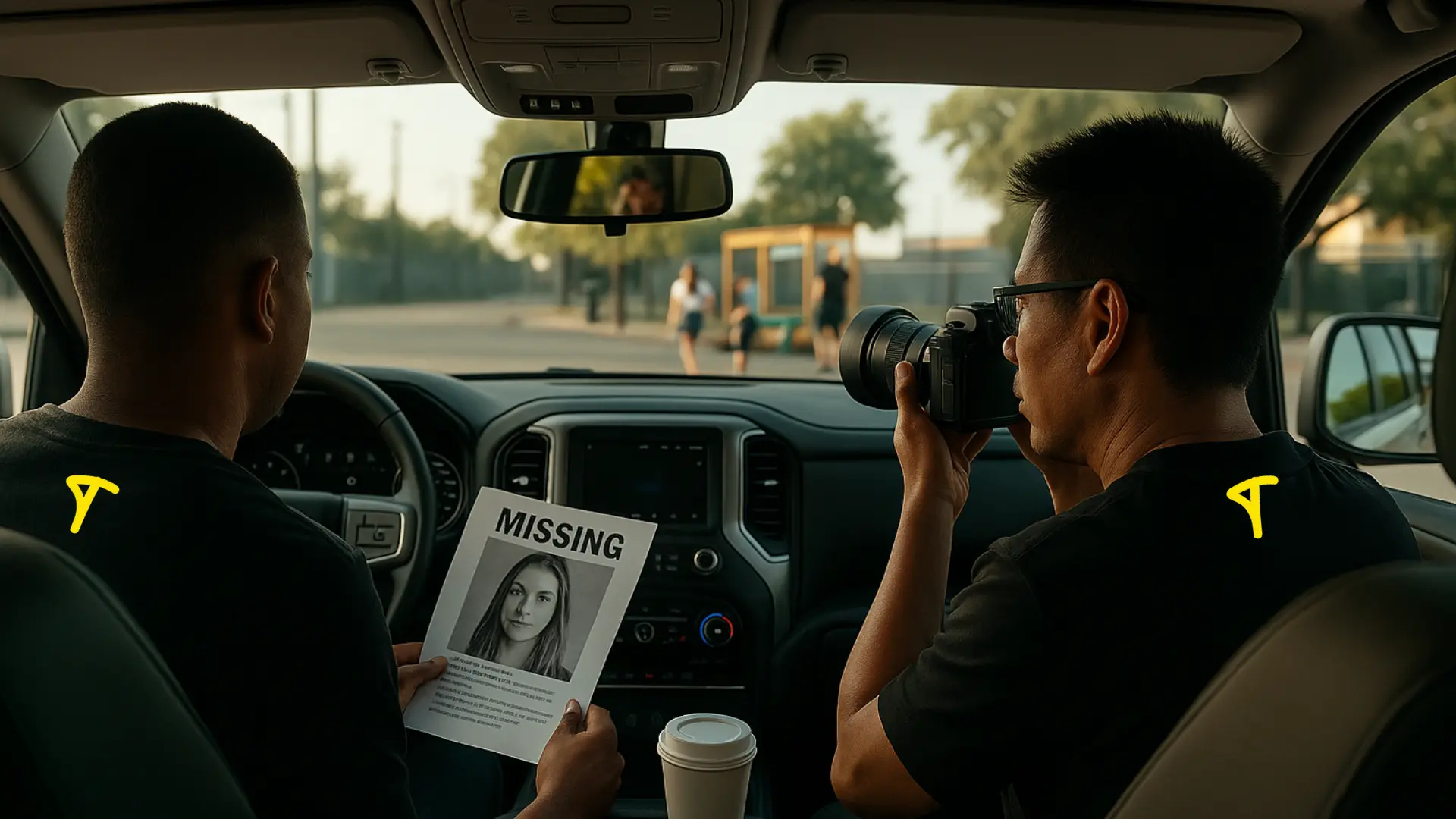
Ours is straightforward. Investigators work in unmarked vehicles, do not announce who they are working for, and disengage rather than press when an approach risks pushing a lead further away.
The second direction is the person you are looking for. A search generates information about somebody who has not consented to any of it, and where that person is a competent adult exercising a choice, we handle what we learn accordingly. We also think carefully about what goes into a public appeal, because details that feel harmless can expose someone who left for their own safety.
On your side, the ordinary risks apply. Shared accounts sync. A relative with a different view may repeat what you tell them. Anything posted publicly is permanent. We adjust how we communicate with you accordingly, including which number and what we put in writing.
If someone you love is missing in Austin, a confidential consultation costs you nothing and may save you from losing hours you cannot get back. Contact us at 512-900-5407, email getanswers@piterrance.com, or read more on our Austin missing persons investigations page. When you are ready, you can start a case online. If you believe there is immediate danger, call 911 first.
13
If you have not filed a police report yet, do that first, today. Then a confidential consultation costs nothing, and we will give you an honest read on what an Austin missing person investigation could realistically establish, including when the honest answer is that the next useful step is not one we should be billing you for.
Real cases, real outcomes. To protect client privacy, names and identifying details have been changed or omitted.

He was 58 years old and had never stopped wondering. Our missing/Locate ...
Her family feared the worst. Our missing person investigator Houston team found ...

Case Overview In early 2025, Terrance Private Investigator and Associates spearheaded a ...
Trust is most of this decision and we know it. See what Austin and Central Texas clients have shared about working with Terrance Private Investigator & Associates. Rated 5.0 on Google with 600+ verified reviews.
Missing person cases do not stay inside one city here. A last sighting on East Sixth becomes an address in Pflugerville, a vehicle on a camera in Round Rock and a friend in Kyle who finally answers on the fourth attempt. We work Travis, Williamson, Hays, Bastrop and Caldwell counties, and we follow a trail out of state when that is where it goes.
Most families who reach out about an Austin missing person investigation have never worked with a private investigator, and almost everyone arrives with the same questions. Here are the honest answers.
There is no waiting period. Not 24 hours, not 48, and it does not matter whether the person is an adult or a child. Texas law requires an agency to accept the report immediately. If anyone tells you to wait, they are wrong, and those hours are the most valuable in the case.
The police, always, and today. A private investigation works alongside a report rather than instead of one. An agency has powers and databases we do not, and filing costs nothing. What we add is dedicated hours and the ability to cross county lines quickly.
We bill hourly for open searches, where cost tracks the field hours required, and by the case for defined work such as a location check. Central Texas distances affect the hours, since a lead in Georgetown and another in Kyle are an hour apart before traffic is counted.
Sometimes, but what happens next matters more. Where we locate a competent adult who does not wish to be found, we do not disclose their location. We confirm they are alive and safe and offer to pass on a message, which is usually what a family actually needs.
That is one of the most common reasons families call, and a closed file rarely means the leads are exhausted. It usually means the case did not meet the threshold to stay active. If we develop something that changes the picture, it goes straight back to the agency.
The one covering where the person was last seen. Inside the city that is Austin Police; elsewhere it may be Round Rock, Cedar Park, Georgetown, Pflugerville, Leander or Kyle police, or a county sheriff. If you are unsure, call anyway. Reports get routed rather than refused.
Yes. You hear from us as leads develop rather than only at the end, because a family waiting in silence is a family we have failed regardless of outcome. You also receive a written report setting out every line of enquiry.
No, and nobody honest will. We do not promise outcomes and we will not sell you hope. What we promise is that the work is done properly, that you are told the truth as we learn it, and that we say plainly when we reach the end of what can usefully be done.
Whatever brought you here, a call that was not returned or a report that has gone quiet, the first conversation is confidential and costs you nothing.