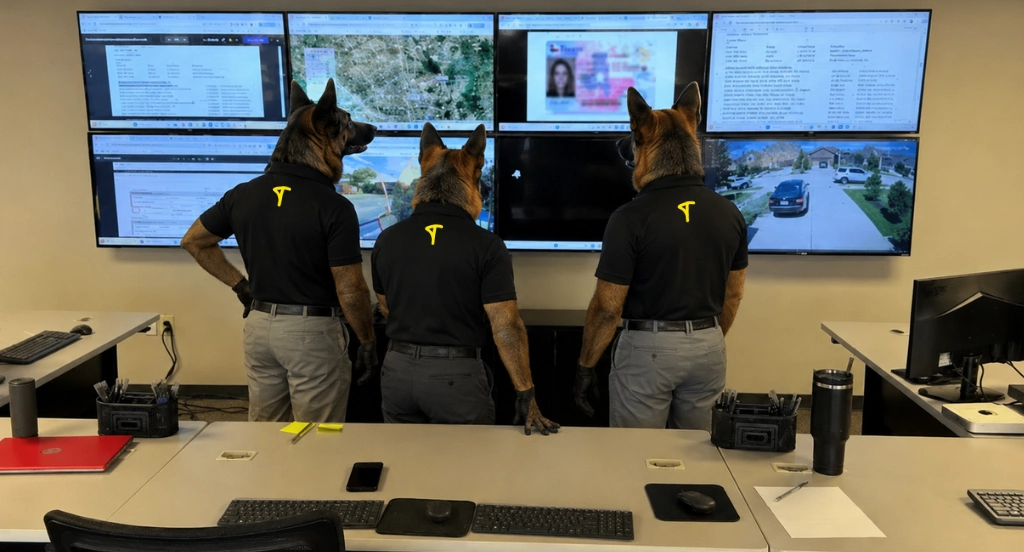


To find a witness for a court case in Atlanta, begin by proving who the person is, and only then ask where they live. In most files we are handed, the witness has not disappeared at all. The paperwork carries an address from two leases ago, a mobile number that has been reassigned, and a name shared by several other people inside the Perimeter. A professional investigator separates the right person from the namesakes, rebuilds the address history across the metro counties, checks each result against the underlying record, and, where service or a subpoena depends on it, confirms on the ground that the person actually lives there today. With reasonable identifiers, a single-subject locate usually resolves within a few business days.
Why does a witness seem to vanish when they have only moved?
Because records describe the past. A commercial database showing somebody linked to an address tells you where a bill or a parcel went at some point. It does not tell you who is sleeping there tonight. In our experience working hundreds of cases nationwide, the most common reason a service attempt fails is that somebody treated a database hit as a confirmed address.
Metro Atlanta sharpens the problem. A large share of the people who end up as witnesses rent, and apartment communities along the Downtown Connector, up GA-400 and around the Perimeter turn over constantly. Somebody who saw a collision in Midtown three years ago may since have lived in Sandy Springs and Kennesaw without ever feeling they had left town.
The quieter failure is misidentification. On a common surname, a data aggregator will merge the records of several people into one tidy profile. The address looks clean and belongs to a stranger. What we see again and again is that nobody notices until a process server is standing at the wrong door.
How do investigators find a witness for a court case in Atlanta?
Identity comes first. Before any address work, we pin the person down with overlapping identifiers: date of birth, former addresses, middle names and initials, maiden and married names, relatives, and past employers. Only when the witness is cleanly separated from everybody who shares the name does the question of where they live begin.
From there the work is layered. Residency and address history, employment, real property, vehicle records where lawfully available, civil and criminal court filings, business registrations and open source research each contribute a piece. We read the underlying record wherever we can instead of trusting the summary a data vendor built from it.
The last step is the one that gets skipped. Where the locate supports service or a subpoena, an investigator attends the address and confirms occupancy. We have found that this single visit prevents more wasted weeks than any database subscription. Our Atlanta witness location investigations page sets out the full process.
If a date is approaching and the file has stopped giving you answers, a short confidential conversation costs nothing and commits you to nothing.
Which counties does an Atlanta witness search have to cover?
More than the one where the case was filed, and this is the part of the job that outsiders underestimate. The City of Atlanta itself sits in two counties, Fulton and DeKalb, and the suburbs spread into Cobb, Gwinnett, Clayton, Cherokee and Forsyth. In Georgia, court filings and land records are kept county by county by each Clerk of Superior Court, so there is no single counter where a metro-wide answer can be requested. The state judiciary’s own site, Georgia Courts, explains how the trial courts are organised by county and circuit.
A witness who moves from the Old Fourth Ward to Decatur has gone a few miles and crossed a records boundary. One who leaves Buckhead for Marietta, or West End for Lawrenceville, has done the same. A search scoped only to Fulton County will return nothing for any of them, and it will return it with complete confidence, which is worse than an error because it reads like a clean result.
We have seen the same pattern in other fast-growing metros, and the answer is to scope by where the person plausibly went, not by where the lawsuit lives. Seven counties is the practical starting point here, and any firm you speak to, ours included, should be able to name the counties it intends to cover before it starts. Our investigators have followed trails well beyond Georgia when an address history stops abruptly. One of our closed matters, in which our investigators found a name on a lease, shows how much a single underlying record can settle.
What can an investigator lawfully do, and what is off limits?
We can research public records and lawfully available data, verify an address in the field, canvass former neighbours and workplaces discreetly, and approach a witness while identifying ourselves honestly. Locating a person for litigation is lawful. The limits sit around how the person is treated once found.
We do not pretext to obtain protected financial, medical or phone records. We do not access anybody’s accounts, devices or private messages, and we do not misstate who we are or why we are asking. The lawful alternative is more record work, patient verification, or a subpoena issued through counsel.
Contact is handled once and on your instruction. If the witness declines to speak, we record the date and circumstances and stop. Georgia treats influencing a witness through threats, intimidation or inducements as a felony, and every contact an investigator makes can be examined later by the other side. We have learned to treat a courteous single approach as the only kind worth making.
There are also things we will not claim. We do not promise to find anybody, we do not describe anything we produce as certain to be accepted by a court, and we do not say a search meets any legal standard of diligence. Those questions belong to your attorney and the judge.
What should you gather before you ask for help?
Everything, including what looks out of date. Full legal name and any former names, date of birth or approximate age, every address in the file however old, employers, vehicles, phone numbers, and any relatives or associates mentioned anywhere in the papers. Address history is the raw material of a locate, and in a market with this much rental turnover it is often the only continuous thread.
Then be candid about the deadline. A locate worked over ten days is a different and less expensive exercise than the same locate started three days before a hearing in Fulton County Superior Court.
What should you do next?
Take it in order. Write down what you know, resist the urge to have a client or relative knock on doors, and get the search scoped properly. If budget is the first question, our guide to what a witness locate costs in this market explains the figures. If the person has been found and has gone quiet, read how to handle a witness who will not cooperate. If it is starting to look as though they cannot be produced at all, what to document when a witness cannot be brought to trial covers the fallback. You can also see how we work across the metro on our Atlanta private investigator page.
Frequently Asked Questions
How do I find a witness who has moved?
Work from address history instead of a single current-address lookup. Former addresses, employers, relatives, property and court records form a trail, and the most recent link in it is then verified. Treat any database result as a lead to be tested, never as an address you would be comfortable serving on.
How long does a witness locate take?
With a full name, a date of birth and one former address, most single-subject locates resolve within a few business days. A common surname, a thin file or a trail leading out of Georgia takes longer, and field verification adds time because somebody has to visit the address in person.
Do you search outside Fulton County?
Yes, every time. The city sits in both Fulton and DeKalb, and the wider metro reaches into Cobb, Gwinnett, Clayton, Cherokee and Forsyth, each with its own Clerk of Superior Court. A search confined to one county will report nothing while the witness lives a short drive away in another.
Should the address be verified in person?
Whenever service or a subpoena depends on it. A records match shows that a person has been associated with an address. A field visit shows who is living there now. In a metro with this much rental turnover, that difference often decides whether the first attempt works or is wasted.
Can I look for the witness myself?
Sometimes, if the name is unusual and the last address is recent. The risks are settling on the wrong person with a similar name, and approaching the right one in a way that makes them unwilling before anyone has taken a statement. Ask your attorney before making contact yourself.
If you have a name and a date, that is usually enough for a useful first conversation. A confidential consultation is free and carries no obligation. Call 404-671-3292 or read more on our witness location service in Atlanta page.