

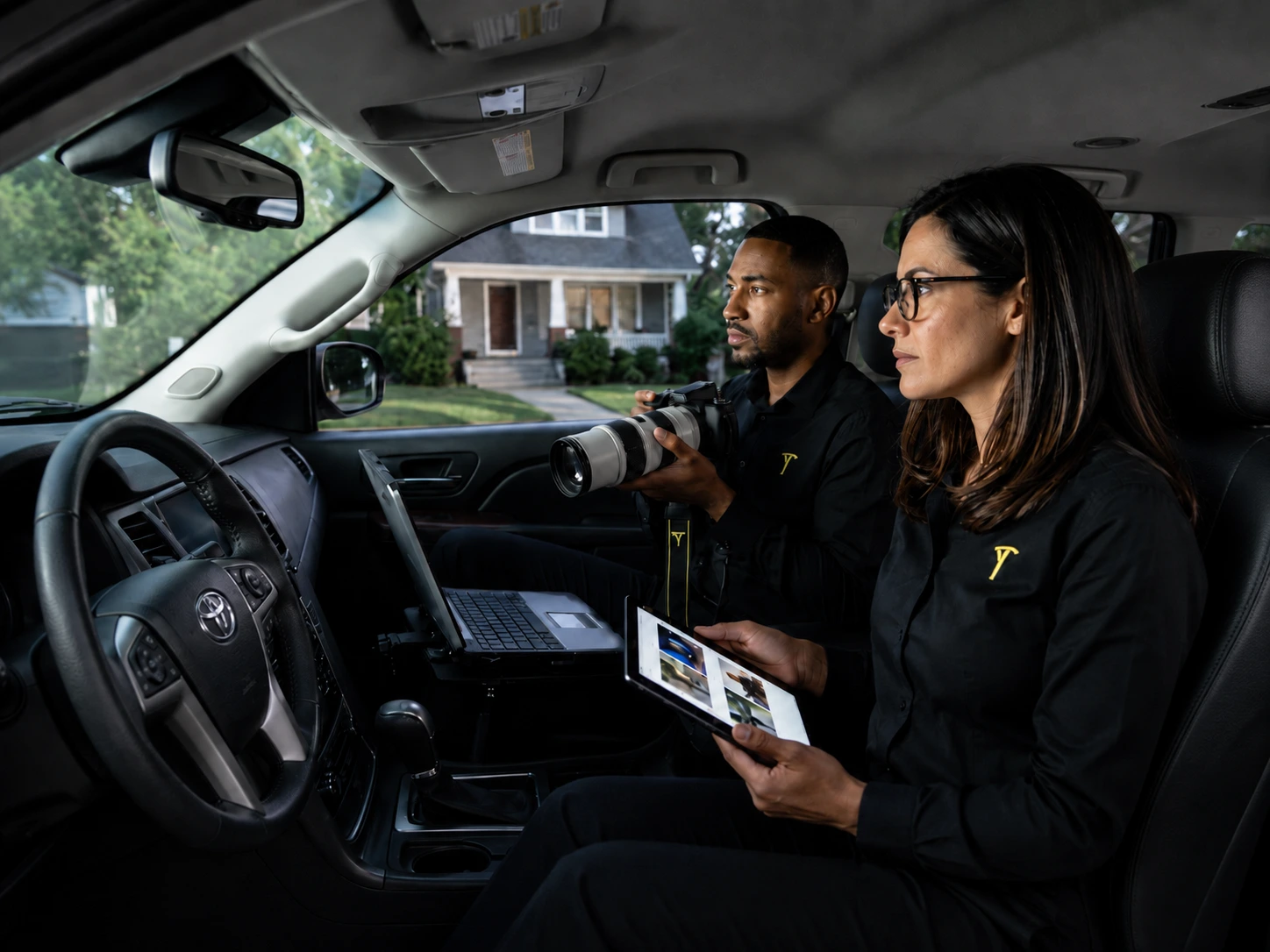
You are leaving work when you notice a vehicle pulling out behind you. Later, you see what looks like the same vehicle near your gym, favorite restaurant, or apartment complex. At first, you tell yourself it is probably a coincidence. Then it happens again, and suddenly you are wondering can a private investigator legally follow you in Texas?
Here is the truth: someone can generally hire a licensed private investigator to conduct lawful surveillance of you in Texas. That may sound unsettling, but it does not mean the investigator has unlimited authority to watch, track, record, or access anything they want. At Terrance Private Investigator & Associates, we know that professional surveillance depends on discretion, sound judgment, and a clear understanding of where lawful investigation ends and unlawful conduct begins.
After 17+ years serving clients nationwide, we have handled surveillance matters involving infidelity, child custody, insurance claims, employee misconduct, civil litigation, missing persons, and other sensitive concerns. Here is what being followed by a private investigator in Texas may actually mean and when the situation could cross the line.
Is It Legal for a Private Investigator to Follow You?
In many circumstances, yes. A properly licensed private investigator may observe and follow a person while that person travels on public roads or participates in activities that are openly visible from a lawful location.
The Texas Department of Public Safety regulates private investigators and other private-security professionals under Chapter 1702 of the Texas Occupations Code. Texas private investigators must be appropriately licensed and affiliated with a licensed company or entity.
A licensed investigator may generally document details such as:
- When you leave or return home
- Where you travel on public roads
- Which vehicle you are driving
- Who you meet in public
- Which businesses or public locations you visit
- Activities visible from a public street or another lawful observation point
So yes, someone may be able to hire an investigator to determine whether your movements match the story they have been given.
And sometimes, that is when the story starts changing.ing which ones fit the situation—and how to use each one lawfully.
Why Would Someone Hire an Investigator to Follow You?
People hire private investigators for more reasons than suspected cheating, although infidelity investigations are certainly one of the most recognized uses of surveillance.
A spouse may want to know whether those unexplained late nights are actually being spent at work. A parent may need evidence concerning a child’s supervision, transportation, living environment, or the people around the child. An insurance company may need to verify whether someone’s publicly observed activities are consistent with an injury claim.
Private investigators may also conduct surveillance for:
- Child-custody investigations
- Insurance and workers’ compensation claims
- Employee or internal investigations
- Civil litigation
- Fraud investigations
- Missing-person cases
- Criminal-defense support
- Business and corporate matters
The purpose of professional surveillance is not to provoke, embarrass, or confront someone. It is to observe what happens naturally and provide the client with accurate, objective documentation.
What Can a Private Investigator Legally Observe?
A private investigator can often observe more than people realize without entering private property or violating anyone’s privacy.
An investigator may generally follow a vehicle on public roads, enter a business that is open to the public, sit in a restaurant as a customer, or observe a residence from a public street. They may also photograph or record activities that are openly visible from a place where they are legally allowed to be.
For example, an investigator may potentially document someone:
- Meeting another person at a restaurant
- Entering or leaving a hotel
- Arriving at a workplace
- Visiting a particular residence
- Performing publicly visible physical activity
- Loading objects into a vehicle
- Leaving a child with another caregiver
The goal is not to gather every detail of a person’s private life. The goal is to document activity that is relevant to the client’s legitimate concern.
You may think nobody noticed who joined you for lunch.
A trained investigator may have noticed the arrival time, the vehicle, the interaction, the location, and exactly when both people left.
What Can a Private Investigator Not Legally Do?
A private-investigator license is not permission to break the law. Investigators do not have the same authority as law-enforcement officers, and they cannot search private property simply because a client wants answers.
A private investigator generally cannot:
- Enter your home without permission
- Climb a fence or enter a private backyard
- Break into your vehicle
- Open your mail
- Hack your phone, email, or social-media accounts
- Enter employee-only or otherwise restricted areas
- Impersonate a police officer
- Threaten, intimidate, or deliberately provoke you
- Ignore a protective order or other court restriction
An investigator also cannot remain on private property after receiving lawful notice that entry is forbidden or being instructed to leave.
Good surveillance requires preparation, patience, and positioning. It should not involve someone hiding behind your backyard furniture or pressing a camera against your bedroom window.
Can a Private Investigator Watch Your House?
A private investigator may generally observe the exterior of a home from a public street, public sidewalk, or another location where the investigator has permission to remain.
From that lawful position, the investigator may be able to document vehicles arriving and leaving, people entering or exiting, departure times, travel patterns, and activities that are openly visible from the street.
However, the investigator cannot enter your yard, bypass a locked gate, enter your home, or position themselves on private property without authorization.
There is a major difference between observing something that is publicly visible and trespassing to obtain a better view.
Professional investigators are trained to recognize that difference and remain on the lawful side of it.
What About GPS Trackers?
GPS tracking is one of the most misunderstood areas of private investigation.
A person should not assume that hiring an investigator automatically gives that investigator permission to place a tracking device on any vehicle. The legality may depend on ownership, possession, consent, authorization, existing court orders, and the specific circumstances surrounding the vehicle.
Certain Texas protective orders can prohibit tracking or monitoring a protected person’s property or vehicle without consent. Those restrictions may include using a tracking application, installing a tracking device, physically following the person, or causing someone else to follow them.
Because the legal analysis can change based on small details, responsible investigators carefully evaluate whether tracking technology may lawfully be used before taking action.
No client should be promised that a GPS tracker can simply be slipped under someone’s vehicle because they paid a retainer.
Is Private-Investigator Surveillance Considered Stalking?
Lawful private-investigator surveillance is not automatically considered stalking.
Professional surveillance normally has a defined investigative purpose. The investigator observes from lawful locations, avoids unnecessary contact, documents relevant activity, and does not threaten or intimidate the subject.
The situation may become more serious when conduct involves harassment, threats, repeated unwanted contact, trespassing, unauthorized tracking, dangerous driving, or violation of a protective order.
Texas protective-order provisions may prohibit conduct directed toward someone, including following them, when that conduct is reasonably likely to harass, alarm, abuse, torment, or embarrass the person.
The difference is not simply whether someone is being watched.
The purpose, methods, location, conduct, and any applicable court orders all matter.
The Truth About Being Followed in Texas
Yes, someone can legally hire a private investigator to follow you in Texas, but the surveillance must still be conducted within the law.
A professional investigator may be able to follow you on public roads, observe you in public places, document publicly visible activities, and report those findings to a client.
They cannot trespass, hack your accounts, enter your home, impersonate law enforcement, threaten you, or use the investigation to get around a protective order.
At Terrance Private Investigator & Associates, our surveillance work is focused on obtaining facts without creating unnecessary confrontations or crossing legal and ethical boundaries.
Because professional surveillance is not about making a scene.
It is about seeing what happens when the subject believes nobody is watching.
Ready to Grow With Us?
If you’re excited by the idea of mastering modern private investigator technology while doing meaningful, ethical work, we’d love to hear from you. At Terrance Private Investigator & Associates, we’ll help you build both the skills and the judgment this career requires.
Explore our current openings and see what it’s like to build a career here.
Helpful Links
- Private Investigator Training
- What Makes a Great Private Investigator?
- Surveillance Investigations
- Texas Association of Licensed Investigators (TALI)
Frequently Asked Questions
Is it legal for a private investigator to follow me in Texas?
Generally, yes. A properly licensed investigator may follow you on public roads and observe publicly visible activity from lawful locations. The investigator must still comply with laws involving trespassing, privacy, harassment, tracking, and protective orders.
Can a private investigator sit outside my house?
An investigator may generally observe a residence from a public street or another location where they are legally allowed to remain. They cannot enter your property without permission or ignore a lawful instruction to leave private property.
Can a private investigator take pictures of me?
An investigator may generally photograph activities that are openly visible from a lawful location. The investigator cannot trespass or use otherwise unlawful methods to obtain photographs or recordings.
Can a private investigator follow me into a restaurant?
Usually, an investigator may enter a restaurant, store, lobby, or other business that is open to the public. They cannot enter restricted areas and must leave if an authorized representative of the property instructs them to do so.
Can a private investigator put a GPS tracker on my vehicle?
Not automatically. Whether GPS tracking is lawful may depend on vehicle ownership, possession, consent, authorization, court orders, and the specific circumstances. It requires careful legal evaluation.
Does a private investigator have to reveal who hired them?
Generally, no. Investigators usually protect their clients’ confidential information unless the client authorizes disclosure or the information must be disclosed through an applicable legal process.
Contact Us
Contact Terrance Private Investigator & Associates
At Terrance Private Investigator & Associates, we understand how frustrating it can be when the facts are unclear and someone’s story no longer makes sense.
Maybe you are concerned about a spouse, worried about your child’s safety, questioning an employee’s conduct, or trying to verify information connected to a legal claim. Whatever brought you here, you deserve answers obtained professionally, discreetly, and lawfully.
With more than 17 years of investigative experience, our team provides surveillance and investigative services for individuals, families, attorneys, businesses, insurance professionals, and organizations across Texas and nationwide.
Reach out today, tell us what is happening, and let us discuss the right investigative approach for your situation.
Email: getanswers@piterrance.com Website: piterrance.com Call or Text: (833) 495 0003
This article is provided for general informational purposes only and does not constitute legal advice. The legality of surveillance may depend on the location, property involved, ownership, consent, technology used, court orders, and the specific facts of the situation.