
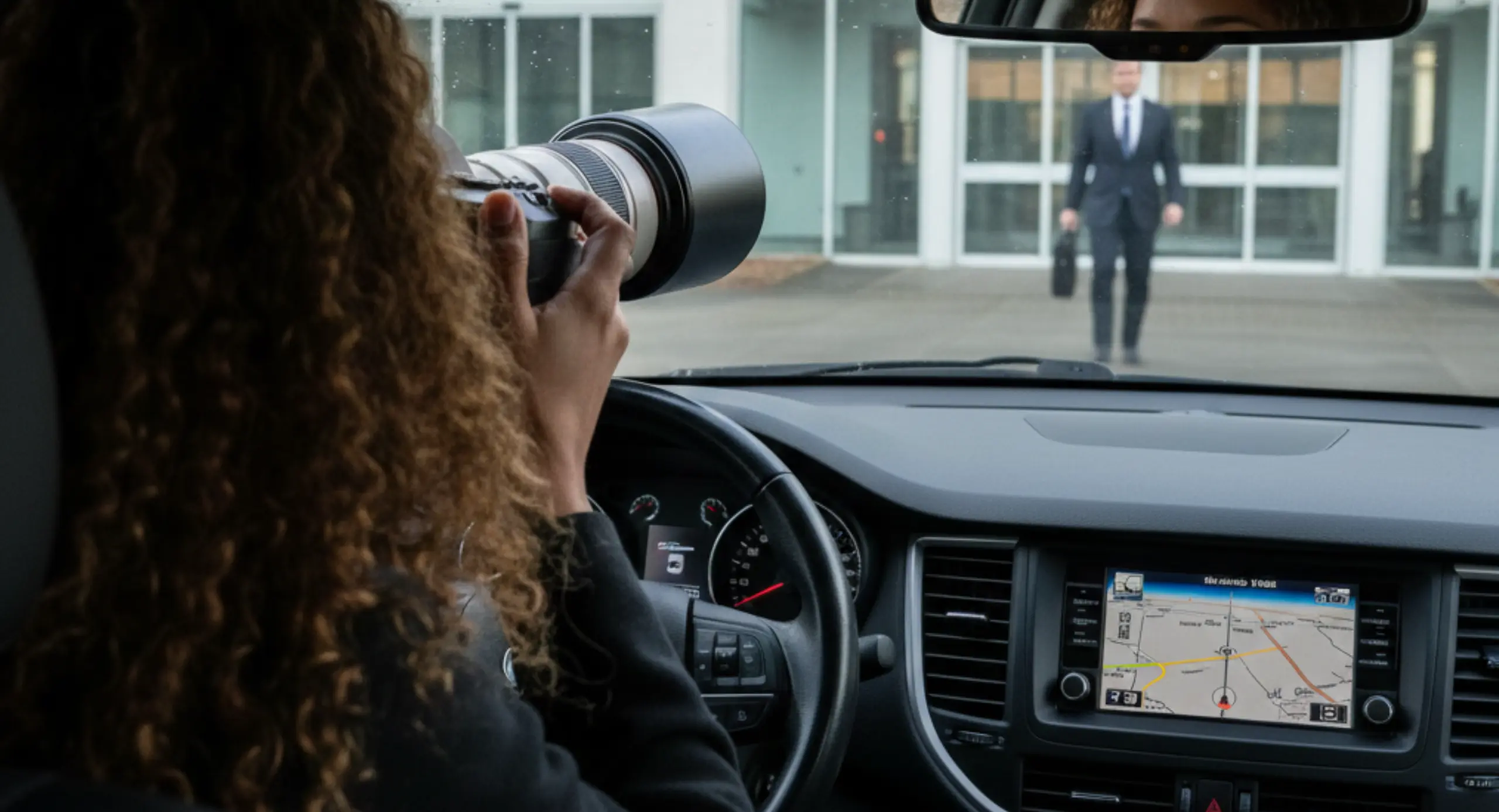
The surveillance cost in Dallas is priced on investigator hours in the field, because that is what surveillance consists of. Some assignments can be quoted as a flat case rate where the question is narrow, such as documenting one specific day or verifying that somebody resides at an address. What moves the number is rarely the investigator’s skill. It is how well the window is known, how far apart the pieces of the subject’s day sit, and whether a route needs one vehicle or two to hold coverage without being noticed.
Here is what sits behind the figure so you can decide whether the work is worth commissioning.
Why hourly is the honest structure for most assignments
Because nobody can tell you in advance how many hours a pattern takes to establish. A subject with a predictable weekday routine and one likely destination can sometimes be documented in a single session. A subject whose activity happens on no fixed schedule may need several sessions across different days before anything meaningful appears.
What makes hourly acceptable is a ceiling. We agree the hours in advance and do not exceed them without your approval, and you hear where things stand as we go rather than at the end. What makes it a problem is an open arrangement with a firm that keeps suggesting one more day.
A flat case rate suits a defined question. Documenting one specific date, verifying occupancy at an address, or covering an agreed number of sessions can all be priced as a single number before anything begins, which is easier to place in a claim file or a matter budget.
What drives the surveillance cost in Dallas more than anything else
Geography, and it is not a throwaway observation about traffic. The Dallas Fort Worth metroplex is built around driving, and that changes the arithmetic of an assignment.
A subject who lives in Plano, works in Las Colinas and spends an evening in Deep Ellum has crossed Collin, Dallas and part of Tarrant County before dinner. Every one of those legs is a follow through congested corridors where a single set of lights can separate an investigator from the subject permanently. On the Dallas North Tollway or the 635 corridor at the wrong hour, one leg can consume an hour that would take fifteen minutes in a compact city.
In our experience working hundreds of cases nationwide, DFW geography is the single most common reason a quote comes back higher than a client expected. It is also why some routes genuinely need two investigators. Holding coverage across a long congested follow with one vehicle means sitting close enough to be noticed, and a firm that never suggests a second investigator on those routes is hoping rather than planning.
If you have reached the point where you need a record rather than an argument, a confidential consultation costs nothing and carries no obligation.
What makes an assignment cheaper
Information you already hold. The more precisely you can describe the window, the fewer hours are spent discovering it rather than documenting it.
Days and times when the relevant activity actually occurs. The vehicle, including the plate. The address the subject leaves from and the likely destinations. Anything you have observed yourself, with dates. Somebody who arrives with a fortnight of dated observations is buying documentation. Somebody who arrives with a suspicion is paying for discovery first and documentation afterwards.
Timing matters too. Booking a specific day you have good reason to think is significant is far more efficient than open coverage across two weeks, and after 17+ years of this work that difference is usually the gap between a bill somebody expected and one they did not.
Put plainly, the surveillance cost in Dallas is a session count multiplied by how far apart the pieces of a subject’s day sit, and both of those are things a client can influence before ever picking up the phone.
When we tell people not to spend
When the window they describe offers no realistic chance. If the concern relates to hours nobody can account for and there is no pattern to work from, an assignment may produce nothing however many hours are purchased.
When the question would be answered more cheaply another way. Records research sometimes settles what a client assumed needed a camera, and we would rather say so.
And when the honest read is that the prospects are poor, we say it on the first call. Billing against an assignment that cannot produce is not a business worth being in, and a client told the truth early tends to return when there is something genuinely workable. We do not promise to document anything, and no honest firm will. What we promise is that the assignment is planned around your situation and that you are told plainly when the odds look poor.
What you receive for the money
A chronological log with dates, times, locations and durations, tied to time-stamped video and photographs referenced against each entry rather than handed over as a loose folder. Vehicles identified by make, model and plate where visible. Other people described as observed.
Periods with no activity of note appear in the record with the hours they took. That is not padding. Continuous documentation is what makes a report defensible, and material that shows only the convenient moments invites an obvious question about what else was watched. You can see the shape of that in a North Dallas assignment where the pattern only appeared on the third session.
What to do next
Write down the window before you call anyone. Days, times, vehicle, addresses, and what you have observed yourself with dates. That single page changes what any firm can quote and it costs nothing to produce.
Then ask what the hourly ceiling is, whether the route is likely to need a second investigator, and what happens if nothing is documented. Our guide to what to look for when hiring covers vetting, where Texas law draws the line covers the legal boundary, and if this concerns a claim, claims surveillance is the relevant piece. Licensing is worth verifying with the Texas Department of Public Safety. See our surveillance investigations page.
What the price does not buy
Worth stating alongside the cost, because it is what separates usable documentation from a liability. Observation and recording happen from public places where there is no reasonable expectation of privacy. We do not trespass, do not enter private property, and do not record into a private area through a window or over a fence.
We also do not record conversations we are not party to, place tracking devices on vehicles a client has no legal authority to track, or access phones and accounts. Every one of those would create exposure for the client rather than for us, and would contaminate the material gathered lawfully alongside it.
If a firm quotes you a lower hourly rate and offers any of that as part of the package, the rate is not the thing you should be comparing.
Frequently Asked Questions
How much does surveillance cost in Dallas?
Most assignments are billed by investigator hours in the field, with a ceiling agreed in advance that we do not exceed without approval. A defined question can be quoted as a flat case rate. DFW distances affect the hours considerably more than most clients expect.
Why would an assignment need two investigators?
Because a long follow across the metroplex at peak hour frequently cannot be held by one vehicle without sitting close enough to be noticed. Where a route crosses several cities on congested highways, the second investigator is the difference between documentation and a lost day.
Can I book a single day?
Often yes, and it is the most efficient option when you have good reason to believe a particular day matters. Open coverage across two weeks costs considerably more and is only worth it where the pattern is genuinely unknown.
Do I pay if nothing is documented?
Yes, because you are paying for the field hours rather than a guaranteed result, and no honest firm can sell an outcome. What we will do is tell you before you engage when the window you describe gives little realistic chance.
Is a cheaper firm a false economy?
Frequently. One investigator sent to cover a route that needed two produces a lost subject and an invoice, and the second attempt costs more than doing it properly would have. Ask how a firm plans coverage before comparing hourly rates.
If you are weighing whether surveillance is the right step, talk it through with somebody who plans these assignments across DFW every week. A confidential consultation is free and carries no obligation, including an honest view on whether the window you can describe is worth working. Call 214-838-8004 or read more on our Dallas surveillance investigations page.