
Workers compensation surveillance in Atlanta is only as useful as it is defensible. If you are an adjuster, a self-insured employer or defence counsel with a file where the reported restrictions and the reported activity do not sit comfortably together, what helps you is a continuous, time-stamped record of what a claimant was seen doing from public places, with the uneventful hours logged alongside the eventful ones. What hurts you is a short clip with nothing around it. Georgia claims are handled through the State Board of Workers’ Compensation, and anything you place in front of that process will be tested by somebody whose job is to ask what else was watched and why it is missing.
Where does surveillance fit in a Georgia claim?
Late, and narrowly. It is not a first step and it is not a substitute for the medical record. It earns its place when there is a specific, observable question: is the claimant working elsewhere, driving when the file says they cannot, or carrying out physical activity on a regular basis that the stated restrictions would seem to rule out.
In Georgia the system is administered by the State Board of Workers’ Compensation. Disputed claims go to a hearing before one of the Board’s administrative law judges, and a party unhappy with that decision can ask the Board’s Appellate Division to review it. How surveillance material is used or weighed anywhere in that process is a matter for counsel and the judge. Our part ends at an accurate record.
The same applies to suspected fraud. The Board has its own Enforcement Division for that, and deciding what a set of observations amounts to is its work and your attorney’s, never an investigator’s.
What does workers compensation surveillance in Atlanta actually document?
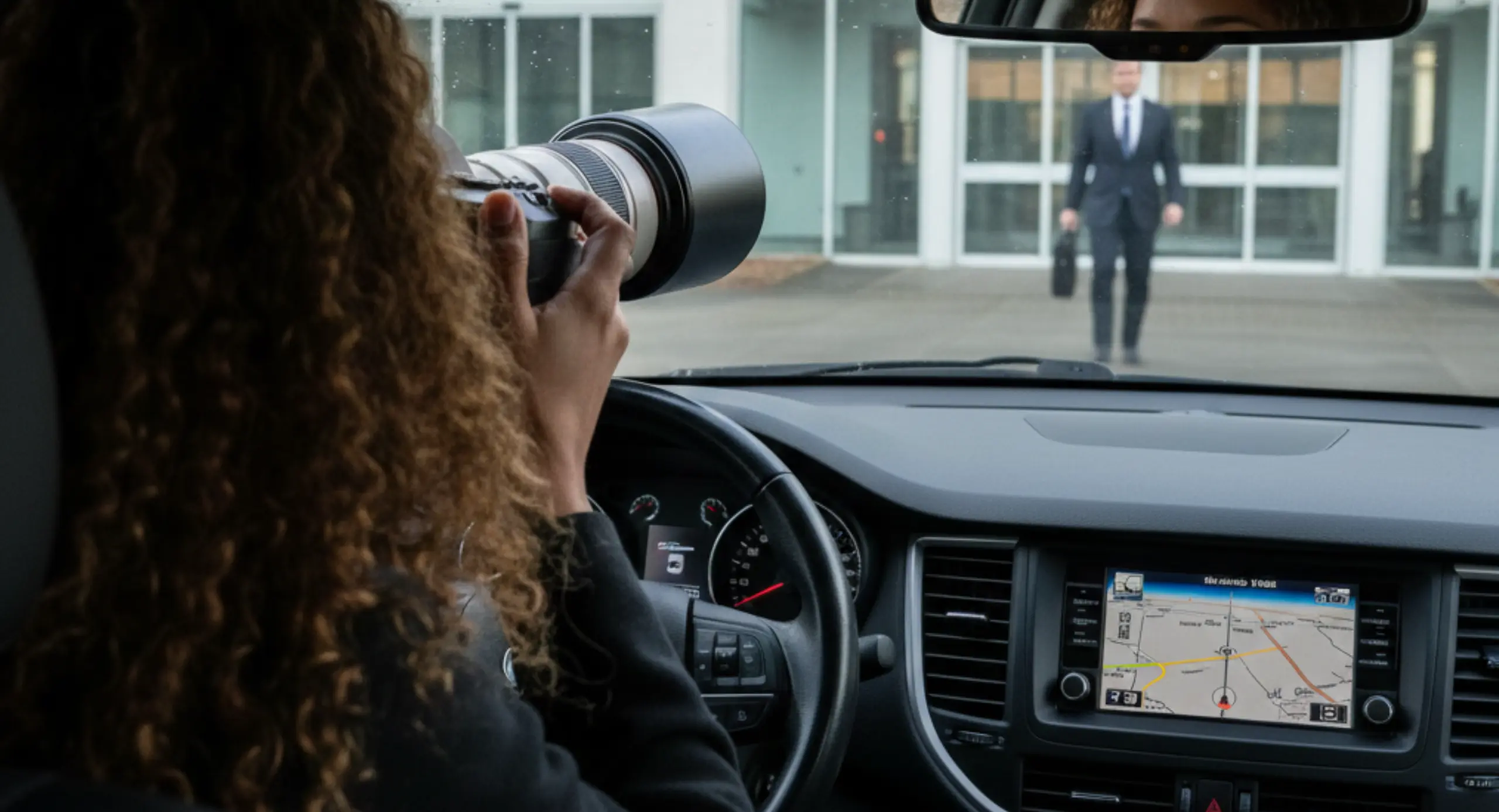
Observable activity and capability, seen from public vantage points. Whether the claimant left home and when. What they carried and how they carried it. How they got in and out of a vehicle. How long they stayed active before resting. Where they went, who was with them, and how long each stop lasted. Every entry carries a time and a location and points to the matching piece of video.
What it never documents is a medical conclusion. We are not clinicians. Whether an activity is consistent with a restriction is a judgment for the authorized treating physician and, if it comes to a hearing, for the judge. In our experience working hundreds of cases nationwide, the reports that hold up best are the plainest ones: observed loading a vehicle unaided for eleven minutes, at this time, at this place.
Why does a thirty-second clip do more harm than good?
Because the first response to it is always the same. What happened in the hours either side? If the record cannot answer, the clip looks selected, and a selected clip invites doubt about the whole file.
We have found that the assignments which come under attack are rarely the ones where nothing was seen. They are the ones where something was seen and the surrounding context was not kept. So we record the quiet periods and report them with the hours they took.
If you are unsure whether a file justifies fieldwork at all, a confidential conversation about it costs nothing and carries no obligation.
How is a claimant session planned around metro Atlanta?
With the map before the camera. A great deal of the workforce lives outside the Perimeter, in Cobb, Gwinnett, Cherokee, Forsyth and Clayton counties, and a claimant’s week tends to be local to home: the pharmacy, a school run, a relative’s house, a side job. That makes the residence the anchor.
Timing is the next task. A claimant with no fixed schedule can leave at any hour or not at all, which is why two or three sessions on different days of the week usually tell you more than one long one. What we see regularly is activity clustered on particular days, a weekend job, or a Saturday spent on a physically demanding project, and a single weekday session would miss all of it.
A known appointment helps. If the file shows a scheduled medical visit or a therapy session, that gives a confirmed time and place to pick up a claimant whose routine is otherwise unknown, and the hours before and after it are often more informative than the visit itself. Our investigators have also learned to plan for the drive back, because a claimant leaving a clinic near Sandy Springs for a home in Lawrenceville is on I-285 and I-85 at exactly the hour both are slowest, and one vehicle may not hold that follow discreetly.
Planned this way, workers compensation surveillance in Atlanta is a scheduling exercise as much as a fieldwork one.
What will we say about a claim, and what will we refuse to say?
We will say what was observed, when, where and for how long.
We will not call a claim fraudulent or a claimant a malingerer. We will not describe footage as conclusive or tell you how a judge will treat it. We will not promise to document anything, because no honest firm can.
The methods have limits too. We observe from public places, where there is no reasonable expectation of privacy. Georgia law prohibits using a device to record a person’s activities in a private place that is out of public view, so we do not film into homes, over fences or through windows, and we do not go onto private property to watch. We do not contact the claimant, approach them under a pretext, speak to their neighbors, place tracking devices on vehicles our client has no legal authority to track, or look into phones, accounts or medical records.
What should a usable report contain?
The agreed scope and the exact periods covered. A chronological log with dates, times, locations and durations. Video and photographs referenced against the entry they belong to. Vehicles by make, model and plate where visible. Other people described as seen, without labels.
And the negative results, set out as carefully as the positive ones. Over 17+ years of casework we have seen a clean record of an uneventful week close a question just as firmly as footage of activity would have. A closed file from another kind of matter, a five-day business surveillance on a warehouse, shows the same discipline of logging every covered period.
What should you send before any fieldwork starts?
The question you need answered, in one or two sentences. The restrictions as currently stated. A description and, if you have it, a photograph of the claimant, their address and their vehicle. Any appointments on the calendar. And the date by which you need the report, since a hearing or mediation date changes how sessions are ordered.
Then agree the ceiling. Our article on how surveillance is priced in Atlanta covers budget, the questions to ask before engaging a firm covers vetting, and Georgia’s legal limits on surveillance covers the boundaries in more detail. You can also see how we scope assignments on our Atlanta surveillance investigators page, or the wider work we do on our Atlanta private investigator page.
Frequently Asked Questions
What does claimant surveillance capture?
Activity visible from public places: departures and arrivals, what was lifted or carried, how the person moved, how long they stayed active, vehicles used and who else was present. It is recorded continuously with time stamps and not trimmed into highlights, because the surrounding context is what lets the material stand up to questions.
Can you tell us whether the claim is fraudulent?
No, and be wary of any firm that says it can. We describe what was observed and stop. Whether activity fits a stated restriction is for the authorized treating physician and the administrative law judge, and suspected fraud in Georgia is a matter for the State Board’s Enforcement Division and your counsel.
How many days of coverage does a file need?
It depends on how much is known about the routine. A confirmed pattern can sometimes be documented in one session. An unknown one usually needs two or three sessions on different days, including a weekend, because activity tends to cluster and a single weekday can easily miss it.
What if the claimant stays home the whole time?
Then the report says so, with the hours covered and what could be seen from a public position. In claims work an uneventful record has real value. It can support the restrictions as stated, and it is part of what makes any later observation of activity believable.
Will the claimant know they were observed?
They should not. Investigators use unmarked vehicles, change position between sessions and break off when a follow becomes conspicuous. We never contact the claimant or anyone around them. If an address cannot be covered without a real risk of exposure, we tell you before starting, not after.
If you have a file where workers compensation surveillance in Atlanta might answer a specific question, talk it through with people who plan this work across Fulton, DeKalb, Cobb and Gwinnett counties. A confidential consultation is free, carries no obligation, and includes an honest view on whether coverage is likely to produce anything. Call 404-671-3292 or read more on our Atlanta surveillance investigations page.