
Workers compensation surveillance in Austin succeeds or fails on defensibility rather than on drama. What a carrier, an adjuster or a self-insured employer needs is continuous documentation with clear time stamps and a log that records the uneventful hours as well as the productive ones. Footage of somebody lifting something, with no record of the surrounding period, is the kind of material that damages a file rather than supporting it, because the first question asked is always what else was watched.
Here is what makes this work hold up, and where it commonly falls apart.
Why continuous beats convenient
A clip showing thirty seconds of activity invites an obvious challenge: what happened in the four hours either side, and why was that not recorded. A log covering the whole session, including the two hours in which nothing occurred, answers that before it is asked.
In our experience working hundreds of cases nationwide, the assignments that get attacked are almost never the ones where nothing was found. They are the ones where something was found and the surrounding context was not preserved. Recording the quiet hours is not padding the invoice, it is what makes the productive minutes usable.
That is also why we report periods with no activity of note along with the hours they consumed. A report containing only adverse observations tells a reviewer what was found but not what was looked at, and those are very different things.
What workers compensation surveillance in Austin actually documents
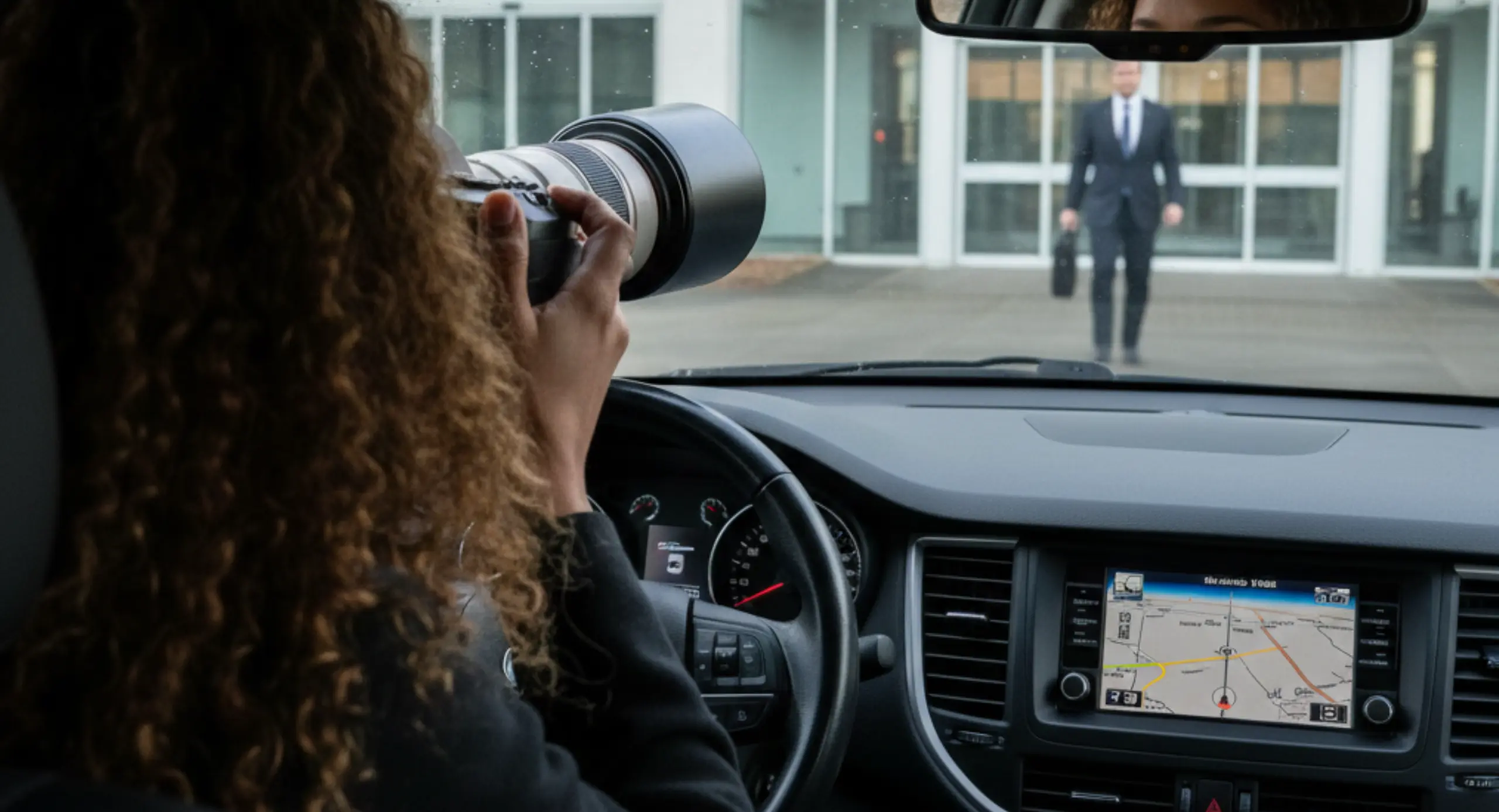
Observable activity and capability, from public vantage points. Whether somebody left the house, what they carried, how they moved, how long they were active, what vehicle they used and who else was present. Times, locations and durations, tied to time-stamped media referenced against each log entry.
What it does not document is a medical conclusion. We are not clinicians and we do not offer a view on whether an activity is consistent with a reported restriction. That determination belongs to a treating physician, a designated doctor or a hearing officer, and an investigator who strays into it creates a problem for the file rather than strengthening it.
The Texas system for these disputes is administered by the Texas Department of Insurance Division of Workers’ Compensation, and how any material is weighed there is a question for the people running that process.
The Austin planning problem
Claimant surveillance is unusually sensitive to geography, and Austin makes it harder than most markets. Growth pushed a great deal of the workforce out into Williamson County toward Round Rock, Cedar Park, Georgetown and Leander, and south into Hays County toward Kyle, Buda and San Marcos, while the work sites remain concentrated in Travis County.
The result is a long commute in both directions on I-35 or MoPac at exactly the hours a session needs to start and finish. A follow from a residence in Georgetown to a site south of the river can consume a substantial part of a day before anything is observed, and holding it through that congestion frequently requires a second investigator rather than one.
Residential access adds to it. Newer developments across the northwest and out toward Westlake are gated or single-entrance, which shifts coverage to the entrance and lengthens the time needed to establish a pattern. None of that is a reason to avoid the assignment, and all of it is a reason to plan and quote it honestly rather than discover it on day one.
Planned properly, workers compensation surveillance in Austin is a scheduling exercise as much as a field one, and the files that produce usable material are almost always the ones where the commute was accounted for before anybody deployed.
If you are weighing whether a file justifies field work at all, a confidential consultation costs nothing and carries no obligation.
What we will and will not say about a claim
We do not promise to document anything, and no honest firm will. We also do not characterise a claim as fraudulent, and we do not describe footage as conclusive or admissible. Those determinations belong to the people whose job it is to make them.
That boundary protects the file. A report asserting that a claimant is malingering is a report that can be undermined by a single alternative explanation, whereas a report stating that the claimant was observed loading a vehicle unaided for eleven minutes at a stated time and place is considerably harder to dislodge. We describe. Others decide.
The methods are equally bounded. We observe from public places where there is no reasonable expectation of privacy. We do not trespass, we do not record into private areas through windows or over fences, we do not record conversations we are not party to, we do not place tracking devices on vehicles our client has no legal authority to track, and we do not access phones, accounts or private communications. Terrance Private Investigator & Associates is licensed by the Texas Department of Public Safety under A30913601.
What a usable report contains
The scope agreed and the periods covered. A chronological log with dates, times, locations and durations. Time-stamped video and photographs referenced against the corresponding entry rather than supplied as a loose folder. Vehicles identified by make, model and plate where visible. Other people described as observed rather than characterised.
And the negative results. Sessions covered with no activity of note, and the hours they took. a closed surveillance matter where the record settled a disputed account shows what that looks like when the record is complete rather than selective.
Everything is delivered in a format an adjuster or defence counsel can work with directly, in declaration form where that is required.
What to do next
Send the file details and the questions you actually need answered, along with any restriction or activity that is genuinely in dispute. Vague instructions produce vague coverage, and a session run without a defined question is the most expensive kind.
Then agree the ceiling before anything begins. Our guide to what surveillance costs here covers budget, what to ask before hiring covers vetting, and the legal boundaries in Texas covers what is permitted. See our surveillance investigations page, and defence counsel can see how we work alongside a matter on our attorneys and legal professionals page.
Frequently Asked Questions
What does claimant surveillance actually capture?
Observable activity from public vantage points: departures and arrivals, what was carried, how somebody moved, duration of activity, vehicles and others present. It is documented continuously with time stamps rather than clipped, because context is what makes the material defensible.
Can you say whether the claim is fraudulent?
No, and be cautious of any firm that offers to. We describe what was observed and stop there. Whether activity is consistent with a reported restriction is a determination for a treating physician, a designated doctor or a hearing officer, not for an investigator.
How many days are usually needed?
It depends entirely on how well the window is known. A precise routine can sometimes be documented in one session. An unknown pattern usually needs several, and Austin commuting distances mean a day covers fewer productive hours than in a compact market.
What if the claimant does nothing?
That appears in the report as a covered period with no activity of note, along with the hours it took. In claims work an uneventful record is frequently as useful as an eventful one, and it is part of what makes the productive sessions credible.
Do gated communities prevent surveillance?
They change it rather than prevent it. We do not enter controlled-access developments to observe, because there is no public vantage point inside. Coverage shifts to the entrance, which takes longer to establish a pattern and is planned and quoted for accordingly.
If you are weighing whether a file justifies field work, talk it through with somebody who plans these assignments across Travis, Williamson and Hays counties. A confidential consultation is free, carries no obligation, and includes an honest view on whether the coverage is likely to produce anything. Call 512-900-5407 or read more on our Austin surveillance investigations page.