

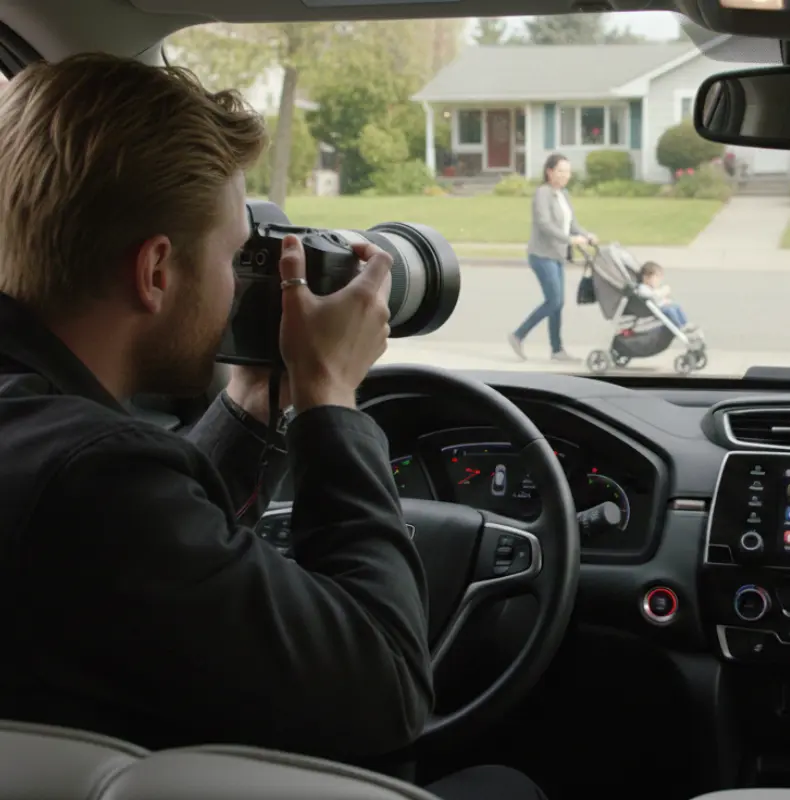
Useful evidence for a Dallas custody case has three qualities: it is dated, it is independent of the parent presenting it, and it was obtained lawfully. Material that fails any one of those tends to hurt rather than help. A chronological log tied to time-stamped video, produced by a licensed investigator who was not a party to the dispute, is the version that survives scrutiny. Screenshots, recollections and anything gathered by entering a home or recording a conversation you were not part of are the versions that create arguments about you.
Here is what each category is actually worth, and what a court-ready report contains.
Why independence is the quality that matters most
Because a parent describing what they saw is a parent with an interest in the outcome, and everybody in the room knows it. The same observation from somebody with no stake in the matter carries differently.
That is the entire value of a third-party record. It is not that an investigator sees more than a parent would. It is that the account arrives without the obvious counter-argument attached to it, and it comes with dates, durations and media rather than recollection.
In our experience working hundreds of cases nationwide, the material that collapses fastest is a parent’s own footage taken while confronting the other parent. It proves the confrontation more clearly than it proves anything else.
What good evidence for a Dallas custody case contains
A chronological log with dates, times, locations and durations. Time-stamped video and photographs referenced against the corresponding log entry rather than supplied as a loose folder. Vehicles identified by make, model and plate where visible. Adults present described as observed, and identified only where lawful research supports it.
It also records what was not observed. A period covered with nothing of note belongs in the document with the hours it took, because a report containing only adverse observations tells a court what was found without telling it what was looked at.
Children are described only as far as necessary to record what happened, and never photographed in a way that serves no evidential purpose. Courts notice that, and so do we.
If you have reached the point where nobody is taking your word for it, a confidential consultation costs nothing and carries no obligation.
What quietly damages your position
Anything obtained unlawfully, every time. Entering the other parent’s property, recording into a private area, placing a device to capture a conversation you are not part of, or tracking a vehicle you have no authority over. Each of those shifts the hearing onto your conduct.
Questioning your child is the other one, and it is more common than any of the above. After 17+ years of this work, the pattern we see most often is a well-meaning parent who asked a few questions, and an opposing attorney who spends twenty minutes on exactly that.
Social media is a weaker category than people expect. Posts are undated in practice, easily cropped and frequently old. Treat them as a reason to look rather than as the thing itself.
How a Dallas matter differs in practice
Mostly through geography. Orders are often entered in one county while a parent has moved to another, so a matter can involve Dallas County, Collin County and an exchange point in neither. That affects where observation can lawfully take place and how a schedule is planned, and it is worth thinking through before anybody deploys.
It also affects residence questions. Establishing where a child actually sleeps when one household has moved from Irving to Frisco is observable, documentable and frequently the fact that matters most. a Dallas custody matter where documentation replaced an argument turned on that kind of straightforward, dated observation.
What to do next
Start with your attorney on what would actually make a difference to your matter, because gathering material nobody needs is expensive and occasionally counterproductive. Then keep a dated log, and let independent observation do the part your own account cannot.
Our guide to documenting a violation covers the most common instruction, what this costs covers budget, and what to ask before hiring covers vetting. Guidance on reporting concerns about a child is published by the Texas Department of Family and Protective Services. See our attorneys and legal professionals page and our child custody investigations page. If you believe a child is being harmed or is in immediate danger, call 911. Suspected abuse or neglect should be reported to the Texas Abuse Hotline on 1-800-252-5400, which is free and carries powers no private firm has. Surveillance is not a substitute for either. We do not promise a result, we do not characterise anybody as a good or bad parent, and we do not offer a view on best interest or on what a Dallas County court will decide. Those are determinations for the court and your attorney.
Sequencing it with your attorney
The order in which this happens changes what it is worth. Gathering first and asking later is how parents end up with material nobody needed, and occasionally with material that raises questions about how it was obtained.
The better sequence is a short conversation with counsel about what is actually in dispute, then documentation aimed at that specific question, then a review of whether it moved anything. Evidence for a Dallas custody case is worth what it changes, and a great deal of what parents instinctively want to prove turns out not to be in issue.
Timing matters too. Material gathered close to a hearing carries more weight than material from eighteen months ago, because the question before a court is usually about the arrangement now rather than the arrangement then.
And keep the scope narrow. A focused record answering one contested question reads considerably better than a broad file that looks like a campaign, and after 17+ years of this work the narrow ones are the ones attorneys tell us were useful.
Frequently Asked Questions
What evidence helps most in a custody matter?
Dated, independent documentation of observable facts, such as exchange times, who collects a child and where they are taken. Its strength comes from being contemporaneous and from not originating with a parent who has an interest in the outcome.
Is video from my phone useful?
Sometimes, though it is weaker than people expect and can backfire when it was recorded during a confrontation. It also proves the confrontation. Independent observation avoids that problem entirely and arrives with dates and durations attached.
Can I use text messages?
Messages you lawfully received are ordinarily fine and your attorney will advise on using them. They establish what was said rather than what happened, which is why they work best alongside documentation of actual events rather than instead of it.
Will an investigator testify?
Where required and where properly instructed, an investigator can speak to what they observed and recorded. What they will not do is offer opinions about parenting, fitness or best interest, because those are determinations for the court rather than for a witness to observation.
What if the report does not help me?
That happens, and it is a real result. Sometimes documentation shows an arrangement working better than a parent feared. We report exactly what was observed and exactly what was not, and we will not inflate a quiet weekend to justify an invoice.
If something during the other parent’s time is worrying you, talk it through with somebody who runs these matters across DFW. A confidential consultation is free and carries no obligation, including an honest view on whether documentation is likely to help. Call 214-838-8004 or read more on our Dallas child custody investigations page.